The Clown Who Slashed a Woman’s Life: 27 Years Later, Science Finally Exposed the Killer’s Real Name
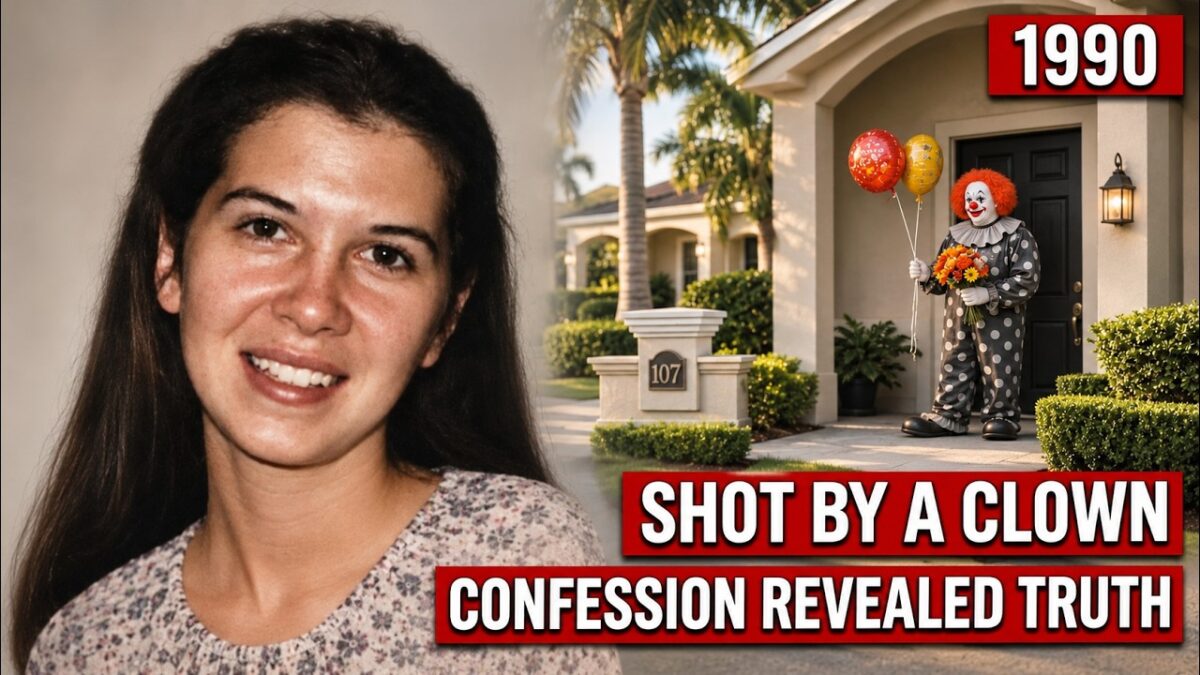
The Clown Who Slashed a Woman's Life: 27 Years Later, Science Finally Exposed the Killer's Real Name
The morning of May 26th, 1990, was unremarkable in the Wellington Aero Club, a gated community nestled alongside a private airstrip in Palm Beach County. It was a Saturday, the kind of day that should have ended with quiet meals and idle conversation. Instead, it ended with a bang.
A white Chrysler LeBaron convertible pulled into the driveway of 15,470 Takeoff Place. The car stopped with a soft hiss of tires on the pavement. From the driver’s seat stepped a figure that did not belong in this world of manicured lawns and air traffic control. The person was dressed in a full clown costume. An orange wig sat atop white grease paint that covered every inch of the face. A red bulb nose protruded from the center of the painted-on smile. In one hand, the figure held a basket of red and white carnations. In the other, they held two mylar balloons. One read, “You’re the greatest.” The other featured Snow White and the Seven Dwarfs.
Forty-year-old Marlene Warren walked to her front door. She was not afraid. She was not suspicious. To her, this looked like a gesture of kindness, perhaps a get-well gift for her son who was inside recovering from a broken leg. She opened the door. She looked at the flowers and the balloons. She smiled.
“Ah, how nice,” she said, or perhaps “how pretty.” The exact words matter less than the fact that they were the last she ever spoke.
The clown did not wait. The figure raised a gun—a .38 or .357 caliber handgun—and shot Marlene point-blank in the face.
There was no scramble. There was no panic. The killer, still holding the balloons and the carnations, walked calmly back to the white LeBaron. They got in, shifted into gear, and drove away at a normal, conversational speed. No screeching tires. No rush. It looked like a delivery driver heading to the next stop.
Twenty-one-year-old Joseph Warren was inside. He had been having breakfast with friends when the shot cracked through the air. He ran to his mother. He looked up to see the clown walking, not running, away from the scene. He later described the killer’s eyes as large and brown. That detail would stay with him for the rest of his life. He jumped into his mother’s car and chased the LeBaron through the streets of Wellington. He couldn’t catch it. By the time he circled back, the paramedics were already on their way.
Marlene Warren was rushed to Palm’s West Hospital in Lochhatchee. She did not die immediately. For two days, she lingered on life support. Joe stayed by her bedside, holding her hand, begging her not to leave. On May 28th, the doctors pulled the plug. Marlene was pronounced dead. She was forty years old.
The flowers and the balloons had been left on the doorstep. The killer had brought props to make a murder look like a surprise. And after pulling the trigger, they just left the evidence sitting next to the blood.
The carnations. The “You’re the greatest” balloon. The Snow White balloon. All of it sat there, a macabre tableau that defied every conventional pattern of crime. State Attorney Dave Arenberg would later describe the act without ambiguity: this was not a random act of violence. It was not a robbery. It was an assassination.
Sheriff’s spokesperson Bob Ferrell, a man who had spent nineteen years in law enforcement, told reporters that this was the strangest crime he had ever encountered. He had no frame of reference for it. A clown with balloons executing a woman at her front door in broad daylight in one of the wealthiest communities in Florida? Then driving off without urgency? It didn’t fit. It didn’t make sense.
But to Marlene’s family, it made a terrible kind of sense. Because before she died, Marlene had told them exactly what would happen.
To understand why a clown would kill her at her own door, you have to understand who Marlene was. In every retelling of this case, the costume gets the headlines. The balloons get the attention. Marlene is often reduced to a doorbell in a gunshot, a victim defined only by the bizarre circumstances of her death. But that is not the full picture.
Marlene May McKinnon was born on April 15th, 1950, in Mount Clemens, Michigan, a small industrial city northeast of Detroit. As a teenager, she married John Arenss. The marriage didn’t last. By the time Marlene was twenty, she was a single mother of two sons: John Jr., whom everyone called Johnny, and Joseph, or Joe.
It was during this period of rebuilding her life that she met Michael Kenneth Warren. Michael was eighteen, two years younger than Marlene. There was an immediate, magnetic pull between them. They married on April 27th, 1972, when Joe was just three years old. Michael stepped into the role of father for both boys. Joe would later say that Michael was the only dad he ever really knew. Whatever happened after that, the bond between stepfather and stepson was real during those early years.
The couple moved south to Florida and built a life that, from the outside, looked like the American dream cranked to full volume. Together, they ran Bargain Motors, a used car lot and rental agency on North Dixie Highway in West Palm Beach. Marlene wasn’t just the name on the paperwork; she was the engine of the operation. She kept the books. She managed deals. She handled the day-to-day logistics that kept the business functional.
Beyond the car lot, the couple assembled a portfolio of rental properties scattered across the West Palm Beach area. Her parents estimated she owned around twenty properties in total, worth roughly a million dollars combined. They also owned an airplane and racehorses. Marlene reportedly worked additional jobs as well, including as a cargo ship inspector. For two people who had started with almost nothing, they had clawed their way into genuine wealth. And Marlene was the one holding most of it.
The properties and major assets were structured in her name. That detail seemed like mere paperwork at the time. It would become the most important financial fact in the entire case.
There is another detail about Marlene that makes this story almost unbearably cruel. She loved clowns. Not casually. She had painted them as a teenager, collecting her own artwork over the years. Her mother, Shirley Twing, shared the same fascination. Shirley kept an entire room in her home filled with clown art, figurines, and memorabilia. It was their thing, a mother-daughter tradition that stretched back decades. Years later, after everything that happened, Shirley would tell a reporter with quiet devastation that she didn’t hate clowns; she just hated one.
In the fall of 1988, the family was shattered by a tragedy that had nothing to do with crime. Marlene’s older son, Johnny Arenss, was killed in a car accident at the age of twenty-two. The loss tore through the family like a fault line. And according to Joe and others close to the couple, the fracture in Marlene and Michael’s twenty-year marriage started right there.
Michael didn’t lean in. He pulled away. He threw himself into the business, spending longer hours at the car lot and growing more distant at home. Joe would later say that instead of getting closer after Johnny’s death, his stepfather got further apart.
Marlene wasn’t just grieving. She was growing suspicious. She believed Michael was having an affair. And more than that, she was afraid.
She began telling the people closest to her that something was wrong. Not vaguely, but specifically. She told her son, Joe. She told her mother, Shirley. She told them the same thing more than once, with a clarity that would haunt everyone who heard it.
“If anything happens to me, Mike did it.”
It wasn’t a passing comment. It wasn’t something she said once in a moment of frustration. She said it repeatedly, with enough conviction that the people around her remembered the exact wording decades later. Marlene Warren saw what was coming. She named the person she believed was responsible.
And nobody—her family, her friends, law enforcement—acted on it in time to save her.
By May of 1990, those words were the only thing standing between Marlene and the truth. But the truth wasn’t just who was suspected. It was a web of infidelity and financial motive that was tightening around her.
To understand the motive, you have to look at the money. Michael Warren had hired a new employee in early 1990 to handle repossessions for Bargain Motors. Her name was Sheila Keane. Sheila Marie Sheltra, born in 1963 in a small town in Southwest Florida, had earned a reputation as a tough, no-nonsense operator. She ran a car repossession business with her husband, Richard Keane, who went by the nickname Spud. Richard was about eighteen years older than Sheila.
Sheila was known for carrying a gun for protection and dressing practically, often in combat boots. She wasn’t someone who blended into a crowd. In January of 1990, Sheila had filed a domestic violence injunction against her husband. A temporary restraining order was granted, and she moved out of the family home and into an apartment on Sable Pine Circle.
The rent on that apartment was paid by Michael Warren.
The neighbors noticed. Several of them told police that they assumed Sheila and Michael were married. The two denied any romantic relationship at the time, but the pattern was hard to ignore. A former Bargain Motors employee named Dela Ward described Michael as a player who attracted women easily. Others around the lot said the relationship between Michael and Sheila was an open secret.
And then there was the conversation that would later send a chill through the case. An attorney named Christopher D’Santis told investigators that roughly a year before the murder, Michael Warren approached him outside a courtroom and asked a hypothetical question: “If a husband killed his wife, what would happen to the wife’s estate?”
D’Santis explained that Florida law at the time had a peculiar wrinkle. A husband convicted of murder couldn’t inherit, but a husband convicted of a lesser charge potentially could. And if a friend did the killing and the husband couldn’t be tied to it as an accessory, he could inherit everything.
D’Santis also recalled something else. He told Michael that a killer dressed as a clown would probably never be identified because witnesses wouldn’t be able to tell whether the person under the costume was a man or a woman.
A year later, a clown knocked on Marlene Warren’s door.
The investigators had a suspect, a motive, and a trail of physical evidence that was visible, linear, and incriminating. But there was a question nobody could answer at the time: If all of this points where it seems to point, why would this case take twenty-seven years to solve?
The answer lay in the gap between knowing and proving. In 1990, the science wasn’t ready. The eyewitnesses described the clown as roughly six feet tall, and several believed the figure was a man. That didn’t match Sheila Keane’s appearance perfectly, and a defense attorney would hammer that inconsistency at trial. The descriptions of the costume conflicted with each other; some recalled a gray mechanic-style jumpsuit, others a white suit with red hearts. None of them matched the yellow and pink clown suit sold at the Spotlight shop where Sheila had bought the costume.
The biggest problem, however, was the hair. Brown strands found in the getaway car were the strongest physical link to Sheila. But DNA technology in 1990 was in its infancy. The lab could only determine that the hair was microscopically consistent with Sheila Keane’s. In plain terms, it could have been hers, or it could have been someone else’s with similar hair. That wasn’t enough to build a murder conviction on.
On top of that, the gun was never found. The costume was never recovered. Without the weapon and without the disguise, prosecutors were working with circumstantial evidence. The case stayed open. And slowly, painfully, it went cold.
While the murder investigation was stalling, a different investigation was closing in on Michael Warren. Five months after Marlene’s murder, in October 1990, law enforcement raided Bargain Motors. What they found went far beyond a used car lot. Michael had been running an elaborate fraud operation. He would sell cars to customers, then repossess the same vehicles and report them as stolen, collecting insurance payouts on cars he had already been paid for. He was tampering with odometers to inflate resale value. He was operating a chop shop.
Michael was arrested. In 1992, he went to trial and was convicted on forty-three of sixty-six counts, including racketeering, grand theft, and odometer tampering. He served roughly four years, from March 1994 until his release on December 31st, 1997.
He walked out of a Florida state prison as a convicted felon, but not as a convicted murderer. The one charge that mattered most—the one tied to Marlene’s death—had never been filed against him.
And here is the part that made the fraud conviction feel almost insulting to Marlene’s family. Under Florida law, because Michael was never convicted of killing Marlene, and because the assets were structured to pass to him upon her death, he inherited the properties, the business, and everything else Marlene had built. The very financial motive that prosecutors believed drove the murder was fulfilled. Michael went to prison for ripping off car buyers. He served his time. He got out. And when he walked free, he walked free as a wealthier man than he had been when Marlene was alive.
The woman who answered her door to a clown still didn’t have justice. The man who may have planned the whole thing had profited from it.
After Michael’s release, something happened that investigators had suspected for years but couldn’t prevent. He and Sheila Keane stopped pretending. Their relationship became open. Within a few years of Michael walking out of prison, the two were living together. For the people who had known Marlene, who had heard her warnings, this was its own kind of cruelty. The affair that may have motivated the murder was now playing out in the open.
In August of 2002, twelve years after Marlene Warren was murdered, Michael Warren married Sheila Keane in Las Vegas. She took his name. The suspect in his first wife’s murder was now legally his second wife.
Whatever you believe about this case, that fact alone tells you something about the kind of man Michael Warren was. He married the woman that every detective in Palm Beach County believed had killed the mother of his children. And he did it in a Las Vegas wedding chapel, as far from the Florida courtrooms as he could get.
The couple left Florida entirely. They relocated to the Tri-Cities region, a quiet stretch of small towns along the Tennessee-Virginia border. They opened a burger restaurant called The Purple Cow in Kingsport, Tennessee. They bought a lakefront home in Abington, Washington County, Virginia. By all outward appearances, they were small-town business owners living a quiet, comfortable life.
But Sheila reinvented herself. She dyed her dark brown hair blonde. She stopped going by Sheila altogether. She told people her name was Debbie, explaining it was a childhood nickname. For roughly seventeen years, the people around her knew her only as Debbie. The repo woman with combat boots became a blonde restaurant owner in the mountains of Virginia.
But rumors have a way of surviving, even across state lines and decades. At The Purple Cow, whispers circulated among the staff. Former employees would later tell investigators that there were stories floating around the restaurant. That Debbie had killed Mike’s ex-wife. That there was something about a clown.

Nobody took it seriously enough to report. It was the kind of thing people mentioned in quiet tones during slow shifts and then let go. After all, Debbie seemed normal enough. She ran the restaurant. She lived by the lake. She wasn’t hiding in a bunker. She was hiding in plain sight.
And then there was the photograph. At some point during their years in Virginia, a photo was taken of Sheila Keane Warren in clown makeup at The Purple Cow, reportedly from a Halloween event. The image of a suspected killer clown voluntarily putting on clown face paint a decade after the murder she was accused of committing became one of the most disturbing artifacts of the entire investigation. A former employee eventually turned that photograph over to police.
Meanwhile, back in Palm Beach County, the case file on Marlene Warren’s murder sat in a cold case unit. Frozen. The investigators who had built the original case had retired or moved on. The physical evidence sat in storage lockers. The witnesses were aging.
In 2014, the Marlene Warren case got a second chance. It came not from a dramatic new lead, but from something far more mundane: grant money. The Palm Beach County Sheriff’s Office cold case unit received federal funding to re-examine unsolved homicides. Marlene’s file landed on the list.
A task force was assembled. They went back to the beginning. Old evidence was pulled from the archives and submitted for testing with forensic technology that hadn’t existed when the crime was committed.
Prosecutor Reed Scott ordered a new kind of analysis on the most critical piece of physical evidence: the brown hair recovered from the white Chrysler LeBaron.
In 1990, the lab could only say the hair was microscopically consistent with Sheila Keane. The new analysis was mitochondrial DNA testing. The profile came back as a match to Sheila Keane Warren. But then came the finding that changed everything. Some of the recovered hairs still had skin cells attached at the root. DNA analysis on those skin cells using nuclear DNA concluded that Sheila Keane Warren was the source.
This was the individualized result that 1990 technology could never have delivered. The gap between knowing and proving had finally been closed.
The science had done what patience alone never could. The hair that had always been there, sitting in an evidence locker for more than two decades, finally told investigators what they had always believed. It belonged to Sheila Keane.
On September 26th, 2017, twenty-seven years and four months after Marlene Warren was killed, Sheila Keane Warren was arrested near her home in Washington County, Virginia. She was in a car at the time. Michael Warren was sitting next to her.
According to assistant state attorney Althia McRoberts, one of the first things Sheila said when she was put in handcuffs was, “Well, are you going to arrest him, too?” She pointed at Michael.
If Sheila Keane Warren acted alone, why would her first instinct be to ask whether her husband was being arrested as well?
The case stalled again. Trial dates were pushed back, postponed, and rescheduled. The defense attacked the DNA analysis, arguing that the samples had been contaminated and that the chain of custody had been broken over the decades of storage. They pointed to torn evidence bags and the death of the key witness who had originally compiled the fiber evidence.
In October of 2022, another problem surfaced. A file that had been missing from the case records for years was discovered out of place in the prosecution’s own office. It was the “clown sighting” file, a collection of tips from people who reported seeing clowns in the Wellington area around the time of the murder.
As the trial date finally approached in April of 2023, the state attorney acknowledged publicly that the case had weakened. The death of the lead crime scene investigator meant the evidence couldn’t be fully authenticated in court.
Two weeks before the trial was scheduled to begin, Sheila Keane Warren accepted a plea deal. She withdrew her not guilty plea and pleaded guilty to second-degree murder.
The terms were a twelve-year sentence with credit for time served. With gain time applied, she would be released in roughly eighteen months.
In the courtroom, when the judge asked Sheila whether she agreed with the factual basis of the plea—that she was responsible for Marlene Warren’s death—she answered yes.
Joe Arenss attended the plea hearing through a Zoom video connection. He had waited thirty-three years for this moment. When the judge gave him the opportunity to speak, Joe kept it brief.
“The only thing I want to say is that through this trial, I didn’t see any remorse. God be with her.”
He had always been certain. From the very first day, from the moment he looked through the front doorway of his family’s home and locked eyes with the person inside the clown makeup, he had known.
“Shila Keane Warren was the murderer of my mother,” he told reporters. “I was there. I saw her eyes. I’ll never forget them.”
Marlene’s mother, Shirley Twing, never got to see it. She had spent thirty-three years waiting for justice. She came so close. In March of 2023, just weeks before Sheila Keane Warren walked into a Palm Beach County courtroom and pleaded guilty to killing her daughter, Shirley Twing passed away.
She kept Marlene’s memory alive through sheer force of will, even when the system seemed to have moved on. And of all the injustices in this case, Shirley’s may be the quietest and the cruelst.
Michael Warren was never charged in Marlene’s murder. Not in 1990. Not in 2017 when Sheila was arrested and pointed at him in the police car. Not in 2023 after the plea was entered.
When a reporter knocked on his door in Virginia and asked if he was involved in Marlene’s murder, Michael responded through the glass without opening it. “Most definitely not,” he said. “I defended Sheila. If I thought she had something to do with this, I wouldn’t have been with her.”
It was the kind of answer that could be read as either loyalty or deflection, depending on what you already believed.
Shila Keane Warren was released from prison on November 2nd, 2024. She and Michael reunited in Virginia. State Attorney Aaronberg called the outcome imperfect justice. “They are back together,” he said. “A convicted murderer and a convicted murderer’s husband living in Virginia. I’d rather have bittersweet than bitter.”
Marlene Warren loved painting clowns when she was a teenager. She kept those paintings for years. Her mother built an entire room around them. It was their shared tradition, something warm and whimsical that connected them across decades. And then a clown came to Marlene’s door carrying flowers and balloons and took her life.
The cruelty of that detail is almost too precise to be real. But it was real. And for thirty-three years, the person who prosecutors say pulled the trigger lived free, changed her name, changed her hair, married the victim’s husband, and served burgers to strangers who had no idea who she was.
This case will always be remembered for the clown, the orange wig, the mylar balloons, the painted smile. That’s what makes the headlines. But that’s not what this story is really about.
It’s about a woman who saw danger coming and told the people she loved. It’s about a son who stared into a killer’s eyes at twenty-one years old and spent the next three decades fighting to be believed. It’s about a mother who collected clown figurines in a room full of memories and died weeks before justice finally arrived.
And it’s about a system that knew the answer in 1990, but took until 2023 to say it out loud.
Marlene Warren was a mother who raised two boys. She was a businesswoman who built a real estate portfolio from scratch. She was an artist who painted clowns as a teenager and kept those paintings into adulthood. She was someone who saw danger coming and had the courage to say it out loud even when nobody acted on her warnings.
She was someone who deserved to grow old, to see her son heal, to hold her grandchildren if she’d had them. She didn’t get any of that. What she got was thirty-three years of being reduced to a headline about a clown. What she got was a guilty plea from a woman who still says she didn’t do it. A husband who was never charged. And a conviction that came three decades too late for the people who needed it most.
Her mother died weeks before the plea. Her older son died years before the murder was even committed. The only person left to stand for Marlene at the finish line was Joe, and he had to do it through a Zoom screen.
Some doors, once opened, never fully close. The door at 15,470 Takeoff Place in Wellington, Florida, is one of them.
The phone call came in at 1:18 p.m. on May 26, 1990, just hours after Marlene Warren collapsed in her front doorway. It was an anonymous woman, her voice clipped and cold. She didn’t speculate. She didn’t ask for a callback. She simply gave two names: Sheila Keane and Mike Warren.
It was a startlingly accurate pointer in a sea of confusion. At that moment, the Palm Beach County Sheriff’s Office had no idea who killed Marlene. They had a body, a gunshot, a white convertible, and a figure in a clown mask who had walked away as casually as a mailman. But that phone call, made while Marlene was still clinging to life on a ventilator, signaled that the killer’s web had already begun to tighten around the family.
Investigators would later call these first seventy-two hours the golden window. The evidence trail was so visible, so linear, and so incriminating that it raised a question that would haunt the case for the next three decades: If the trail was this clear, why did it take twenty-seven years to follow it all the way to a conviction?
The answer lies in the gap between suspicion and proof. And that gap was filled with a complex web of infidelity, financial motive, and the primitive limitations of 1990 forensic science.
The first major break came from a costume shop on South Dixie Highway. Two nights before the murder, on the evening of May 24, a woman walked into the Spotlight Costume Shop right at closing time. She was urgent. She insisted she needed a clown costume immediately and couldn’t wait for the next delivery.
Deborah Offord, the shop employee on duty, described the customer to detectives later. She was a tall woman, roughly five foot ten, with long, thick, chocolate brown hair and big brown eyes. The description would stick in the minds of the investigators for decades.
The woman bought everything the killer would need. She purchased a full clown suit, an orange wig, a red bulb nose, and enough white face makeup to cover an entire face. Crucially, she did not buy clown shoes. When detectives asked her why, she mumbled something about female footwear.
Two days later, a clown shot Marlene Warren.
When the news broke, the Spotlight shop’s owner called the Sheriff’s Office. He had seen the coverage and recognized the purchase. When detectives showed Offord a photo lineup, she positively identified the woman as Sheila Keane. A second employee, less certain, said it looked like her.
The costume was just the first piece. The next day, a second phone call arrived from a Publix supermarket on Military Trail, roughly half a mile from the apartment Sheila Keane was living in. Two employees remembered a white woman with long brown hair tied in a ponytail coming in about ninety minutes before the shooting. She bought a basket of red and white carnations and two Mylar balloons.
One balloon read, "You're the greatest." The other featured Snow White and the Seven Dwarfs.
The employees described her as having male mannerisms. That detail would matter later when eyewitnesses at the scene described the clown as a man. But the physical evidence was undeniable. The specific brand of Mylar balloons was only sold at that particular Publix. The trail was short, direct, and leading straight to Keane.
Then came the car.
Four days after the murder, on May 30, a white Chrysler LeBaron was found abandoned in a wind Dixie parking lot on the corner of Okeechobee Boulevard and Royal Palm Beach Boulevard, about eight miles from the crime scene. The car had been reported stolen from Pless Car Rental roughly a month before the killing, back on April 15.
This was where the investigation turned dark.
Claude Puatre, an employee at Bargain Motors, told investigators that roughly forty-five days before the murder, he had driven Michael Warren and Sheila Keane to the Pless rental lot. He watched them drive off together in a white LeBaron. Michael had told him, clearly and specifically, not to tell anyone about it.
It was a small detail, a casual instruction between business partners, but it became the linchpin of the prosecution’s theory. It linked Michael, the victim’s husband, to the getaway vehicle. And it linked Sheila, the car’s passenger, to the crime scene.
When forensic technicians processed the abandoned LeBaron, they found orange synthetic fibers that matched the type of material used in clown wigs. They also found several strands of long brown human hair.
When investigators searched Sheila Keane’s apartment, they recovered more orange and yellow acrylic fibers and two pairs of black lace-up shoes. Under microscopic analysis, the orange fibers found in the car, on Keane’s shoes, on the balloon ribbon, and from a comparison wig purchased at the same costume shop were identical in composition. Burgundy fibers found on Keane’s boots matched the carpet inside the LeBaron.
The trail ran from the costume shop to the supermarket to the car to Keane’s apartment. Every piece connected. It was a physical chain of evidence that looked, on its surface, ready for prosecution.
But to understand why this case stalled, you have to understand the human beings at the center of it. And that means understanding Michael Warren.
Before May 1990, Michael Warren was a successful businessman. He and Marlene ran Bargain Motors, a used car lot and rental agency in West Palm Beach. They had built a life that looked like the American dream cranked to full volume. They owned a portfolio of roughly twenty rental properties, an airplane, and racehorses. The assets were mostly in Marlene’s name. That structure, seemingly innocent paperwork, would become the financial engine of the murder.
In early 1990, Michael hired Sheila Keane’s husband, Richard, who went by the nickname "Spud," to handle repossessions for the car lot. That brought Sheila into Michael’s daily orbit.
Sheila was twenty-six years old at the time. She had a reputation as a tough, no-nonsense operator from her own car repossession business. She carried a gun, wore combat boots, and dressed practically. She didn’t blend into a crowd.
In January 1990, Sheila filed a domestic violence injunction against her husband, Richard. A temporary restraining order was granted. She moved out of the family home and into an apartment on Sable Pine Circle.
According to investigators, the rent on that apartment was paid by Michael Warren.
The neighbors noticed. Several of them told police that they assumed Sheila and Michael were married. The two denied any romantic relationship at the time, but the pattern was hard to ignore. A former Bargain Motors employee, Dela Ward, described Michael as a player who attracted women easily. Others around the lot said the relationship between Michael and Sheila was an open secret.
Here is the piece that turned suspicion into something darker: the financial architecture of the Warren family made Marlene worth more dead than alive to the people closest to her.
Assistant State Attorney Ali McRoberts later explained the implication plainly. By Marlene dying before Michael, he was able to obtain one hundred percent of the assets. If they had divorced instead, the split would have been contested, messy, and potentially devastating for Michael.
And then there was the conversation that still sends a chill through this case.
An attorney named Christopher DiSantis told investigators that roughly a year before the murder, Michael Warren approached him outside a courtroom and asked a hypothetical question. "If a husband killed his wife, what would happen to the wife’s estate?"
DiSantis explained that Florida law at the time had a peculiar wrinkle. A husband convicted of murder couldn’t inherit, but a husband convicted of a lesser charge potentially could. And if a friend did the killing and the husband couldn’t be tied to it as an accessory, he could inherit everything.
DiSantis also recalled telling Michael that a killer dressed as a clown would probably never be identified because witnesses wouldn’t be able to tell whether the person under the costume was a man or a woman.
A year later, a clown knocked on Marlene Warren’s door.
The investigators had a suspect. They had a motive. They had a trail of physical evidence. And they had a financial architecture that pointed toward conspiracy.
So why didn’t they arrest Sheila Keane in 1990?
The answer is the same one that tormented detectives for the next twenty-seven years: the difference between knowing something and proving it beyond a reasonable doubt in front of a jury.
Michael Warren had an alibi for the morning of the murder. He was in a car with friends on his way to Calder Race Track in Miami Gardens when Marlene was shot. Multiple witnesses confirmed this. He was ruled out as the trigger man. Whatever role he may have played in planning the murder, he wasn’t the person at the door.
But the case against Sheila had problems of its own.
The eyewitnesses at the Warren home that morning described the clown as roughly six feet tall. Several of them believed the figure was a man. That didn’t match Sheila Keane’s appearance perfectly, and a defense attorney would hammer that inconsistency at trial.
Worse, the eyewitness descriptions of the actual costume conflicted with each other. Some recalled a gray mechanic-style jumpsuit. Others described a white suit with red hearts or a blue dotted outfit. None of those matched the yellow and pink clown suit sold at the Spotlight shop. If the jury couldn’t agree on what the clown was wearing, how could they be certain who was wearing it?
The biggest problem, though, was the hair.
Those brown strands found in the getaway car were the strongest physical link between Sheila Keane and the crime scene. But DNA technology in 1990 was in its infancy. The lab could only determine that the hair was microscopically consistent with Sheila Keane’s. In plain terms, it looked like hers under a microscope, but there was no way to distinguish it from the hair of hundreds of thousands of other women with similar characteristics.
That wasn’t enough to build a murder conviction on.
On top of everything, the gun was never found. The costume was never recovered. Without the weapon and without the disguise, prosecutors were working with circumstantial evidence. The trail was strong, but it was not airtight.
Internally, the prosecution was divided. Some wanted to move forward. Others argued for patience. Assistant State Attorney McRoberts later described it as an agonizing debate about whether to charge now or keep building.
Detective Paige McCann put it more directly. "You get one shot at a murder trial. If you roll the dice and the jury comes back not guilty, double jeopardy means you can never try again. Sometimes patience is the best strategy."
There was also the question of Michael Warren himself. Even if they could convict Sheila Keane of pulling the trigger, prosecutors believed this was a conspiracy. They believed Michael was involved. Charging Sheila alone without being able to prove Michael’s role felt like solving half the puzzle. Some investigators hoped that if they waited, one of the two would eventually turn on the other.
That never happened.
So the case stayed open. And slowly, painfully, it went cold. Not because anyone stopped caring, but because the science of 1990 could not deliver what the evidence demanded. The trail was there. It had been there since the first seventy-two hours, but the tools to walk it all the way to a conviction didn’t exist yet.
While the murder investigation was stalling, a different investigation was closing in on Michael Warren. And what it uncovered showed exactly who he was beneath the surface of the successful Florida businessman.
Five months after Marlene’s murder, in October 1990, law enforcement raided Bargain Motors. What they found went far beyond a used car lot.
Michael Warren had been running an elaborate fraud operation. He would sell cars to customers, then repossess the same vehicles and report them as stolen, collecting insurance payouts on cars he had already been paid for. He was tampering with odometers to inflate the resale value of vehicles. He was operating what amounted to a chop shop, stripping cars for parts and cycling them through the system.
It was a sophisticated, multi-layered scheme, and it had been going on for years.
Michael was arrested in October 1990. In 1992, he went to trial and was convicted on forty-three of sixty-six counts, including racketeering, grand theft, and odometer tampering. He claimed the prosecution was retaliation, that the state was punishing him because he hadn’t been cooperative enough in helping solve Marlene’s murder.
Whether that was true or not, the fraud was real, the convictions were real, and Michael Warren went to prison. He served roughly four years from March 1994 until his release on December 31, 1997, New Year’s Eve.
He walked out of a Florida state prison as a convicted felon, but not as a convicted murderer. The one charge that mattered most, the one tied to Marlene’s death, had never been filed against him.
And here is the part that made the fraud conviction feel almost insulting to Marlene’s family. Under Florida law, because Michael was never convicted of killing Marlene, and because the assets were structured to pass to him upon her death, he inherited the properties, the business, and everything else Marlene had built.
The very financial motive that prosecutors believe drove the murder was fulfilled.
Michael went to prison for ripping off car buyers. He served his time. He got out. And when he walked free, he walked free as a wealthier man than he had been when Marlene was alive.
The woman who answered her door to a clown still didn’t have justice. The man who may have planned the whole thing had profited from it.
After Michael’s release, something happened that the investigators had suspected for years but couldn’t prevent. He and Sheila Keane stopped pretending.
Their relationship, which both had denied throughout the murder investigation, became open. Within a few years of Michael walking out of prison, the two were living together. For the people who had known Marlene, who had heard her warnings, who had watched her die and then watched nobody get arrested, this was its own kind of cruelty.
The affair that may have motivated the murder was now playing out in the open. And nobody could do anything about it.
In August 2002, twelve years after Marlene Warren was murdered at her own front door, Michael Warren married Sheila Keane in Las Vegas. She took his name. Sheila Keane Warren. The suspect in his first wife’s murder was now legally his second wife.
Whatever you believe about this case, that fact alone tells you something about the kind of man Michael Warren was. He married the woman that every detective in Palm Beach County believed had killed the mother of his children. And he did it in a Las Vegas wedding chapel as far from the Florida courtrooms as he could get.
The couple left Florida entirely. They relocated to the Tri-Cities region, a quiet stretch of small towns along the Tennessee-Virginia border that was about as far from the Palm Beach County spotlight as you could get without leaving the country.
They opened a burger restaurant called The Purple Cow in Kingsport, Tennessee. A no-frills spot that served a local clientele who had no connection to the Warren name or the Wellington crime scene. They bought a lakefront home in Abington, Washington County, Virginia, valued at roughly $600,000. The lakehouse was about a fifty-minute drive from the restaurant.
By all outward appearances, they were small-town business owners living a quiet, comfortable life in the Appalachian foothills.
But Sheila did something that investigators would later point to as deeply telling. She reinvented herself.
She dyed her dark brown hair blonde. She stopped going by Sheila altogether. She told people her name was Debbie, explaining it was a childhood nickname. For roughly seventeen years, the people around her—employees at the Purple Cow, neighbors on the lake, regulars at the restaurant—knew her only as Debbie.
She had effectively shed her old identity. The repo woman with combat boots and brown hair became a blonde restaurant owner in the mountains of Virginia.
But rumors have a way of surviving, even across state lines and across decades.
At the Purple Cow, whispers circulated among the staff. Former employees would later tell investigators that there were stories floating around the restaurant, that Debbie had killed Mike’s ex-wife, that there was something about a clown. Nobody took it seriously enough to report. It was the kind of thing people mentioned in quiet tones during slow shifts and then let go.
After all, Debbie seemed normal enough. She ran the restaurant. She lived by the lake. She wasn’t hiding in a bunker somewhere. She was hiding in plain sight, which is the most effective kind of hiding there is.
There was another detail that investigators would later find deeply unsettling. At some point during their years in Virginia, a photograph was taken of Sheila Keane Warren in clown makeup at the Purple Cow. It was reportedly from a Halloween event at the restaurant.
The image of a suspected killer clown voluntarily putting on clown face paint a decade after the murder she was accused of committing became one of the most disturbing artifacts of the entire investigation. A former employee eventually turned that photograph over to police.
Meanwhile, back in Palm Beach County, the case file on Marlene Warren’s murder sat in a cold case unit. It wasn’t forgotten by the detectives who had worked it, but it was frozen. The investigators who had built the original case had retired or moved on to other assignments. The physical evidence sat in storage lockers. The witnesses were aging.
And every year that passed made the already difficult prospect of a successful prosecution a little more unlikely.
Richard Keane, Sheila’s first husband, the man she had been married to when the murder occurred, died in 2016. Whatever he knew or didn’t know about what happened in May of 1990 went with him.
This is the part of the story that’s hardest to sit with. For seventeen years, the prime suspect in one of the most recognizable unsolved murders in Florida history was living under a fake name, running a burger restaurant, and serving customers who had no idea who she really was.
And the man she married, the man whose first wife had been shot to death by a clown at their front door, was sitting across from her every evening in a lakeside home that was purchased with money that had once belonged to Marlene.
The trail was strong. The evidence was clear. But the case had stalled, not because the facts were ambiguous, but because the technology to prove them didn’t exist yet. The hair in the car was a mystery because 1990 DNA tech couldn’t identify it. The conflicting witness accounts were a problem because juries require consistency, not just possibility. And the financial motive was a theory, not a fact, unless you could prove the conspiracy.
So the case sat. It sat while Michael went to prison for fraud. It sat while he got out. It sat while he married the suspect. It sat while they moved to Virginia, changed their names, and served burgers to strangers.
And it sat for twenty-seven years.
Until the science changed.
But for the people living in the meantime, the silence was deafening.
While the detectives in Palm Beach debated the limits of fiber analysis and the reliability of witness memory, Michael Warren was navigating a very different kind of labyrinth. In October 1990, five months after Marlene was shot, law enforcement raiding Bargain Motors didn't just uncover a used car lot; they uncovered a sophisticated criminal enterprise. Michael had been selling cars to customers, then repossessing those same vehicles and reporting them as stolen to collect insurance payouts. He was tampering with odometers, stripping cars for parts, and running a chop shop disguised as a dealership. It was a multi-layered fraud that had been going on for years.
The arrest was brutal in its irony. Michael went to trial in 1992 and was convicted on 43 of 66 counts, including racketeering and grand theft. He claimed it was all retaliation, that the state was punishing him because he wasn't helping solve Marlene's murder. Whether that was true or not, the convictions were real. He served roughly four years in a Florida state prison, from March 1994 until the stroke of midnight on December 31, 1997. He walked out of that prison on New Year’s Eve, a convicted felon, but not a convicted murderer.
That distinction saved him.
Because Michael was never charged with killing Marlene, Florida law allowed him to inherit everything. The rental properties, the car lot, the investments—all structured in Marlene’s name to protect the family, now flowed freely to him. The very financial motive that prosecutors believed drove the murder was fulfilled while the killer went free. Michael went to prison for ripping off car buyers. He served his time. And when he walked free, he walked free as a wealthier man than he had been when Marlene was alive.
The woman who answered her door to a clown still didn't have justice. The man who may have planned the whole thing had profited from it.
After his release, the pretense fell away. Michael and Sheila Keane stopped denying their relationship. They moved in together. For the people who had known Marlene, who had heard her chilling warnings, who had watched her die and then watched nobody get arrested, this was its own kind of cruelty. The affair that may have motivated the murder was now playing out in the open. And nobody could do anything about it.
In August of 2002, twelve years after Marlene Warren was murdered at her own front door, Michael Warren married Sheila Keane in Las Vegas. She took his name. Sheila Keane Warren. The prime suspect in her husband’s first wife’s murder was now legally his second wife.
Whatever you believe about this case, that fact alone tells you something about the kind of man Michael Warren was. He married the woman that every detective in Palm Beach County believed had killed the mother of his children. And he did it in a Las Vegas wedding chapel as far from the Florida courtrooms as he could get.
The couple left Florida entirely. They relocated to the Tri-Cities region, a quiet stretch of small towns along the Tennessee and Virginia border that was about as far from the Palm Beach County spotlight as you could get without leaving the country. They opened a burger restaurant called The Purple Cow in Kingsport, Tennessee. It was a no-frills spot that served a local clientele who had no connection to the Warren name or the Wellington crime scene. They bought a lakefront home in Abington, Washington County, Virginia, valued at roughly $600,000. The lakehouse was about a 50-minute drive from the restaurant. By all outward appearances, they were small-town business owners living a quiet, comfortable life in the Appalachian foothills.
But Sheila did something that investigators would later point to as deeply telling. She reinvented herself.
She dyed her dark brown hair blonde. She stopped going by Sheila altogether. She told people her name was Debbie, explaining it was a childhood nickname. For roughly 17 years, the people around her—employees at the Purple Cow, neighbors on the lake, regulars at the restaurant—knew her only as Debbie. She had effectively shed her old identity. The repo woman with combat boots and brown hair became a blonde restaurant owner in the mountains of Virginia.
But rumors have a way of surviving, even across state lines and across decades.
At the Purple Cow, whispers circulated among the staff. Former employees would later tell investigators that there were stories floating around the restaurant. That Debbie had killed Mike’s ex-wife. That there was something about a clown. Nobody took it seriously enough to report it. It was the kind of thing people mentioned in quiet tones during slow shifts and then let go. After all, Debbie seemed normal enough. She ran the restaurant. She lived by the lake. She wasn't hiding in a bunker somewhere.
She was hiding in plain sight. Which is the most effective kind of hiding there is.
There was another detail that investigators would later find deeply unsettling. At some point during their years in Virginia, a photograph was taken of Sheila Keane Warren in clown makeup at the Purple Cow. It was reportedly from a Halloween event at the restaurant. The image of a suspected killer voluntarily putting on clown face paint, a decade after the murder she was accused of committing, became one of the most disturbing artifacts of the entire investigation. A former employee eventually turned that photograph over to police. It was a chilling echo of the morning at 15,470 Takeoff Place.
Meanwhile, back in Palm Beach County, the case file on Marlene Warren’s murder sat in a cold case unit. It wasn't forgotten by the detectives who had worked it, but it was frozen. The investigators who had built the original case had retired or moved on to other assignments. The physical evidence sat in storage lockers. The witnesses were aging. And every year that passed made the already difficult prospect of a successful prosecution a little more unlikely.
This is the part of the story that’s hardest to sit with. For 17 years, the prime suspect in one of the most recognizable unsolved murders in Florida history was living under a fake name, running a burger restaurant, and serving customers who had no idea who she really was.
And the man she married—the man whose first wife had been shot to death by a clown at their front door—was sitting across from her every evening in a lakeside home that was purchased with money that had once belonged to Marlene.
But for Joe Arenss, the years in the shadow of that home were not quiet. They were a suffocating fog.
Joe was 21 when his mother was killed. He had already lost his brother Johnny in a car accident two years earlier. Now his mother was gone too. Murdered in front of him in the most bizarre and traumatic way imaginable. And the people he believed were responsible were walking free.
Joe spiraled. He turned to alcohol and drugs, trying to numb the grief and the rage and the helplessness that came with knowing that the system had failed his mother. The addiction consumed years of his life. Years he should have spent building a career, starting a family, living the kind of life Marlene had worked so hard to give him. Instead, he was drowning in the aftermath of a crime that nobody seemed able to solve.
He carried the image of those big, brown eyes through the doorway of his family home. He remembered the clown walking, not running, back to the white Learon. He remembered the calm confidence of the killer who believed she was never going to be caught. He had chased that car through the Wellington streets in his mother’s vehicle, fueled by adrenaline and terror, only to watch it disappear into the distance.
Every year, the anniversary of the murder arrived like a physical blow. Every time the case showed up in a true crime documentary or a podcast, the wound never fully closed because the case was never fully resolved. He lived in a state of perpetual waiting, watching Michael and Sheila live their lives while Marlene’s legacy was reduced to a financial asset and a cold case file.
It took a long time, but Joe eventually found his way into recovery. Even sober, though, the open wound of the unsolved case was always there. He was a man in his 30s, then his 40s, defined not by his own accomplishments, but by the unsolved murder of his mother. He was the witness who saw the face. He was the son who chased the car. He was the living proof that the truth had been right there, in plain sight, for decades.
And then, in 2014, the machinery of justice finally shifted.
It didn't come from a dramatic new lead or a deathbed confession. It came from something far more mundane. Grant money.
The Palm Beach County Sheriff's Office cold case unit received federal funding to re-examine unsolved homicides. The kind of cases that had been sitting in filing cabinets and evidence lockers for decades, waiting for someone to look at them again with fresh eyes and better tools. Marlene’s file landed on the list.
A task force was assembled, pulling together detectives from the sheriff’s office, the state attorney’s office, and the FBI. It wasn't one or two people working the case in their spare time. It was a coordinated effort with resources and institutional support. The kind of commitment that cold cases rarely get but desperately need.
They went back to the beginning. Witnesses who had been interviewed in 1990 were tracked down and re-interviewed. Some of them three decades older and scattered across different states. Former employees of Bargain Motors, neighbors from Sable Pine Circle, people who had been at the scene that morning. Some remembered details they hadn't been asked about the first time. Others had lost clarity after so many years. The process was slow, but it was thorough.
Old evidence that had been sitting in storage for over two decades was pulled from the archives, cataloged, and submitted for testing with forensic technology that hadn't existed when the crime was committed.
Prosecutor Reed Scott, who had begun revisiting the case around 2013, ordered a new kind of analysis on the most critical piece of physical evidence: the brown hair recovered from the white Chrysler Learon, the getaway car.
In 1990, the lab could only say the hair was microscopically consistent with Sheila Keane. That meant it looked like hers under a microscope, but there was no way to distinguish it from the hair of hundreds of thousands of other women with similar characteristics.
The new analysis was mitochondrial DNA testing, a technique specifically designed for older, degraded samples like hair strands that have lost their root cells. The mitochondrial DNA profile from the hair shaft came back as a match to Sheila Keane Warren. It was a strong indicator, though mitochondrial DNA is inherited maternally and shared by everyone in a maternal line. So it narrowed the pool without pinpointing a single individual.
Then came the finding that changed everything.
The hair wasn't just a rootless strand. Some of the recovered hairs still had skin cells attached at the root. And DNA analysis on those skin cells, using nuclear DNA rather than mitochondrial, concluded that Sheila Keane Warren was the source.
This was the individualized result that 1990 technology could never have delivered.
FBI testing confirmed the findings. State attorney Dave Arenberg summarized what the science now showed. The hairs found in the Learon were able to be traced to Sheila Keane through DNA technology that simply did not exist at the time of the murder.
The gap between knowing and proving had finally been closed. The science had done what patience alone never could. What was impossible in 1990 was now a matter of laboratory procedure. The hair that had always been there, sitting in an evidence locker for more than two decades, finally told investigators what they had always believed. It belonged to Sheila Keane.
The cold case work hadn't been glamorous. It wasn't a dramatic midnight phone call or a surprise confession. It was years of painstaking reanalysis, filling out grant applications, shipping old evidence to new labs, waiting for results, cross-referencing findings, and rebuilding a case from the ground up with the tools of a new century.
Detective McCann’s philosophy from 1990 had been vindicated. Patience was the strategy, and the science caught up.
But catching up came with a price. The years of silence had allowed the defense to harden, the evidence to degrade, and the memory of witnesses to fade. The case that was irrefutable on paper in 2017 was facing the same legal hurdles that had stalled it in 1990: the difficulty of proving a conspiracy, the conflicting descriptions of the clown, and the fact that the gun was never found.
The trail was clear, but the road to a conviction was paved with legal delays and biological limitations. The system had caught up with the killer, but it had also aged with her.
And in a lake house in Virginia, under a name that wasn't her own, Sheila Keane Warren was still waiting for the other shoe to drop. She didn't know it yet, but the net was tightening. The federal grants had paid for the science, but they hadn't bought back the years lost to the silence.
The clock was ticking. And for the first time in 27 years, it wasn't just a metaphor.
The 2014 investigation did not begin with a dramatic breakthrough. It began with a form.
It was a federal grant application, sitting on a desk in the Palm Beach County Sheriff’s Office, requesting funding to re-examine a backlog of unsolved homicides. For the people who had spent decades staring at the Marlene Warren file, the document was mundane. It was bureaucratic, quiet, and easy to overlook. But for the evidence sitting in metal lockers in the dark, it was a lifeline.
The task force assembled that year was different from the 1990 team. The original detectives were gone, retired or reassigned. In their place was a coordinated effort involving the FBI, the state attorney’s office, and forensic specialists who had never seen a 1990 case file before. They didn’t just re-interview witnesses; they went back to the physical proof. They pulled the bags that had sat untouched for twenty-four years. They looked at the hair strands from the white Chrysler LeBaron. In 1990, those strands were all the prosecution had. Under the microscopes of that era, the lab report had been honest but weak: the hair was "microscopically consistent" with Sheila Keane. That meant it looked like hers. It meant it didn’t prove she was there. It was a circle of probability, not a line of fact.
By 2014, the circle had closed.
The forensic team ordered mitochondrial DNA testing. This was technology designed for old, degraded samples. It looked for genetic markers passed down through the maternal line. The result was a match. But the true turning point came when the lab discovered that some of the hair strands recovered from the car still had root cells attached, or at least enough nuclear material attached to the shaft to run a full profile. The new analysis did not just show the hair was *like* Sheila’s. It showed it *was* Sheila’s. The FBI confirmed the findings. The technical report stated clearly that the DNA profile of the hair strands found in the getaway car matched Sheila Keane Warren.
For the first time in twenty-seven years, the gap between suspicion and proof had vanished. The science had delivered what the law had needed all along.
Detective Paige McCann, who had watched the case stall in the early nineties, later reflected on this shift. In 1990, the choice between charging and waiting had been agonizing. The evidence was strong, but it was circumstantial. The gun was missing. The costume was missing. The hair was ambiguous. To go to trial then would have been a gamble with double jeopardy waiting on the other side. Now, the gamble was over. The DNA was irrefutable. The trail from the costume shop to the supermarket, to the abandoned car, and finally to Keane’s apartment was no longer a web of theories. It was a chain of facts, each link verified by modern genetics.
The indictment followed on August 31, 2017. A grand jury in Palm Beach County returned charges against Sheila Keane Warren for first-degree murder. The document was thin, but the weight behind it was massive. It represented 27 years of patience, frustration, and cold case limbo ending in a single legal directive.
But the legal directive was not the end. It was the start of a new, painful delay.
The arrest came on a Tuesday morning in September. Investigators from the Washington County Sheriff’s Office in Virginia, working alongside Palm Beach County detectives, found Sheila Keane Warren in a car parked near her lake house. She was driving with her second husband, Michael Warren, sitting in the passenger seat. The officers knocked on the window. The moment it would later be remembered for was not the handcuffing, but the question that came out of the car.
According to Assistant State Attorney Althia McRoberts, one of the first things Sheila said, as the officers approached her, was, "Well, are you going to arrest him, too?"
She pointed at Michael.
The law enforcement officers did not answer. They did not need to. The implication hung in the air, heavy and chilling. If she had acted alone, why was her first instinct to shield the man who had built his fortune on his first wife’s death? Why ask if her accomplice—her alibi-maker, her financier, her husband—was safe?
Sheila waived extradition the next day. She was transported to Florida, held without bond, and the state announced it would seek the death penalty.
For Joe Arenss, the arrest was a violent shockwave. He had spent three decades carrying the image of those brown eyes staring back at him through the clown makeup. He had carried the silence, the addiction, the feeling that his mother’s death was a secret buried under layers of stone. Now, the stone was moving. The system that had failed him in 1990 was finally speaking. He had been right. He had been right about the eyes. He had been right about the lie.
But the road from arrest to conviction was not straight. It was paved with delays.
The trial was scheduled, then postponed. Then rescheduled, then postponed again. By 2020, the global pandemic had shut down courtrooms, adding months of stagnation to a case that had already waited thirty years. The defense strategy sharpened its focus on the age of the evidence. The primary defense attorney, Greg Rosenfeld, attacked the integrity of the DNA results. He argued that the samples had been stored for decades, that the chain of custody had been broken, and that the key witness who had originally documented the physical evidence had died before the trial could begin. Without that witness, the prosecution could not fully authenticate the physical trail.
Rosenfeld was not just delaying; he was eroding. He pointed to torn evidence bags. He highlighted the absence of the weapon and the costume. He argued that the mitochondrial DNA profile was not unique to Sheila, but could match a percentage of the population. He even suggested the hair could have belonged to the victim, Marlene, not the killer.
The prosecution’s case, which had felt airtight in the lab, looked fragile in the courtroom. The witnesses from 1990 were old, some had passed away, and the memories of the few remaining were blurred by time. The "clown sighting" file, a bundle of uninvestigated tips, surfaced in 2022, giving the defense another angle to attack. They argued that alternative suspects had never been properly eliminated.
The trial date for April 2023 approached with the weight of a collapsing bridge. State Attorney Dave Arenberg, who had guided the case through its final years, faced a brutal choice. He could risk a jury verdict on first-degree murder and face a high probability of a not-guilty verdict due to the compromised evidence. Or, he could take a deal.
Two weeks before the trial was set to begin, the deal was struck.
On April 11, 2023, Sheila Keane Warren appeared before Palm Beach County Circuit Judge Scott Sisco. She withdrew her not-guilty plea. She pleaded guilty to second-degree murder. The sentence: twelve years.
The courtroom was quiet. The judge asked for a factual basis. "I was responsible for Marlene Warren’s death," Sheila Keane Warren said. Her voice was flat, clinical.
Then the judge turned to the victim’s family. Joe Arenss was not in the room. He was in a living room, miles away, waiting on a Zoom video connection. He had waited more than half his life for this moment. When his face appeared on the screen, his eyes were red-rimmed. He had prepared a statement. He wanted to talk about the trauma, the years of addiction, the grief. But when he opened his mouth, the words came out short, sharp, and exhausted.
"The only thing I want to say is that through this trial, I didn't see any remorse," Joe said. "God be with her."
It was not a victory speech. It was the sound of a man who had been waiting for the other shoe to drop for thirty-three years and had finally watched it land on his foot.
The plea was a legal certainty, but it was not justice. It was a transaction. The state traded the risk of a first-degree murder trial for a guaranteed second-degree conviction. They traded the possibility of life in prison for twelve years. And because the murder occurred in 1990, the sentencing laws were based on the more generous good-time credits of that era.
The math was cold. Twelve years. But with pre-trail jail credit and good behavior adjustments, the actual time Sheila Keane Warren would spend in a cell was calculated to be roughly sixteen to eighteen months.
Sheila’s attorney, Richard Luben, held his head high afterward. He told reporters that his client maintained her innocence. That the plea was a pragmatic decision to avoid a high-risk trial. He called it a "huge win."
State Attorney Arenberg called it "imperfect justice."
The word "imperfect" did the heavy lifting. It acknowledged that a woman who had likely murdered another woman at point-blank range, who had fled the state, changed her name, dyed her hair, and married her victim’s husband, was going to spend less than two years in a Florida correctional facility. It was a system buckling under the weight of time. It was a system that had let the evidence degrade, the witnesses age, and the killer live for three decades.
The most brutal footnote of this part of the story belongs to Shirley Twing.
Shirley had waited. She had waited through the initial investigation, through the cold case years, through the rumors, and through the federal grants. She had kept a room full of clown art, a room that was now a shrine to her daughter’s murder. She had told reporters that she hoped Sheila would rot in hell. She had kept the story alive in the public consciousness simply by refusing to let it die.
In March of 2023, four weeks before Sheila Keane Warren entered the courtroom to plead guilty, Shirley Twing died.
She did not get to see it. She did not get to watch the woman she blamed on TV. She did not get to say the words she had held in her throat for thirty years. The finish line moved past her by a matter of days. It is one of the quietest cruelties in the entire case. Her daughter was a victim of a system that prioritized procedure over people, and the system kept moving even as the women who loved Marlene were disappearing one by one.
Bill Twing, Marlene’s stepfather, was still alive when the plea was entered. He did not direct his anger at Sheila. He directed it at Michael Warren.
"I don't think that you've done it," Bill told a reporter, his voice raspy with age. "But I know pretty damn well that you know more about it than you're letting out."
It was a statement that carried the weight of thirty years of frustration. It was not a legal accusation. It was a certainty. A certainty that the truth was out there, sitting in a lake house in Virginia, in the silence of a man who had been indicted for fraud but never for murder.
Michael Warren was never charged in Marlene’s death. He was a person of interest. He was the one Sheila pointed at in the police car. He was the one who had asked a lawyer how to inherit a dead wife’s estate. But he was not the one convicted. He was not the one who served time for her murder.
When a reporter knocked on his door in Virginia in 2023, Michael did not open it. He spoke through the glass.
"Most definitely not," he said, referring to his involvement in the murder. "If I thought she had something to do with this, I wouldn't have been with her."
The answer was smooth. It was the answer of a man who had protected himself for thirty years. It was a shield. Whether it was a reflection of loyalty or a deflection of guilt, it did not matter to the court. It mattered only to the people who had lost Marlene.
On November 2, 2024, the doors of the Florida prison opened.
Sheila Keane Warren walked out. She had served roughly eighteen months of her twelve-year sentence. The math had worked in her favor, just as her attorney had promised. She was a free woman. She was a convicted murderer, but she was free.
She went back to Virginia. She went back to the lake house. She went back to Michael Warren.
The reunion was not dramatic. There were no press conferences, no dramatic scenes. There was just the quiet return of a wife to her husband. The two of them, the architect and the instrument of Marlene’s death, were together again.
State Attorney Arenberg summed up the feeling of the case with a single, weary line. "I'd rather have bittersweet than bitter."
But for the Warren family, the taste was not sweet. It was not bittersweet. It was just bitter.
Joe Arenss went to his mother’s grave after the plea. He stood there, in the quiet of the cemetery, and he spoke to her. He told her they had finally gotten the truth. He told her she had finally won. It was a lie, not because it was factually wrong, but because it was too small. A guilty plea from a woman who still claimed innocence. A release after eighteen months. A husband who had never been charged.
It was not the closure he had chased for thirty years. It was a door closing in a room where the fire was still burning.
Marlene Warren was not a headline. She was not a clown. She was not a mystery. She was a woman who loved flowers, who painted clowns, who warned her family about her husband, and who was shot in the face at her own front door.
For thirty-three years, she was a riddle. Now, she was just a body in a grave, and the people who killed her were alive, well, and together.
The case did not end with a bang. It ended with a release date on a prison record. It ended with a Zoom call that felt too sterile for the gravity of the moment. It ended with a mother dying weeks before her daughter’s killer was convicted.
The system had caught up with the killer, but it had not caught up with the crime. It had not caught up with the pain. It had not caught up with the thirty years of silence that followed that Saturday morning in 1990.
Sheila Keane Warren is not behind bars for twelve years. She is not behind bars for life. She is walking out the door. And the door at 15,470 Takeoff Place in Wellington, the door that opened to a bouquet of carnations and a painted smile, is the only one that stays shut.
The justice was delayed. It was imperfect. It was, in the end, just enough to say that the law noticed. And that, for Marlene Warren, was not enough. It was never going to be enough. But it was the only truth the system had left to give.