El secreto del Alfa permaneció enterrado.
.
.
hasta que el niño empezó a hacer preguntas.
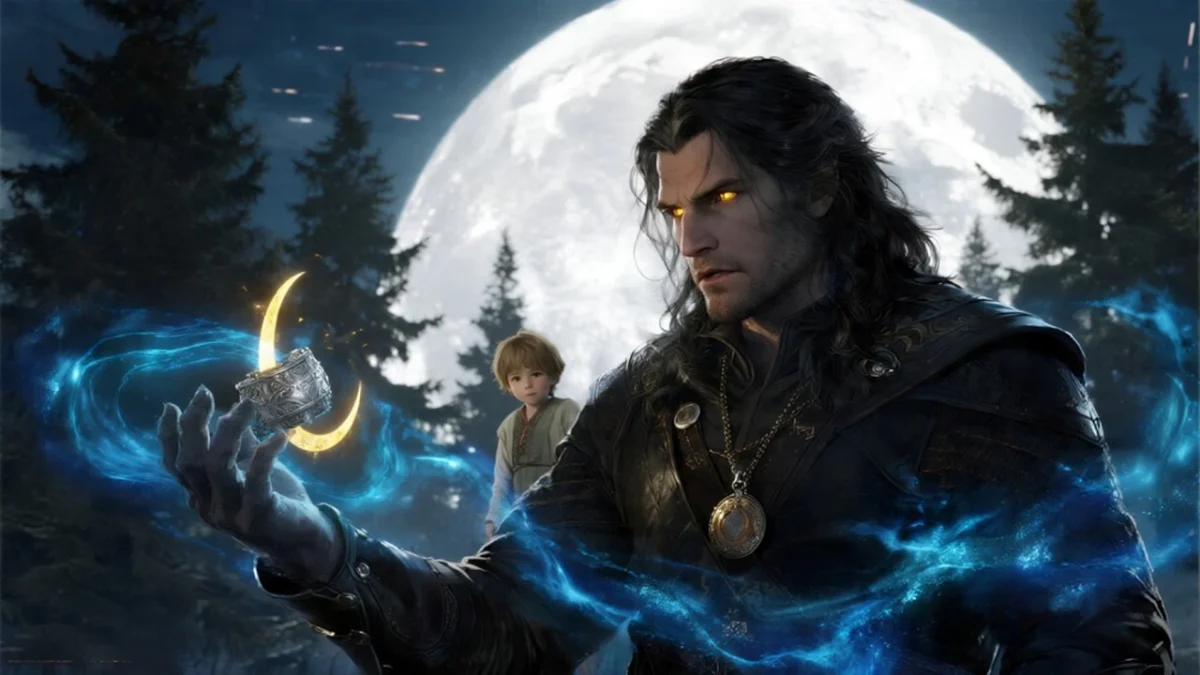

He told everyone she was dead.
He buried the truth so deep even the earth forgot.
He ruled his pack with iron claws and a cold golden eye.
And no one dared question him.
No one.
Until a seven-year-old girl tugged at his armor with trembling fingers, looked up at him with tears streaming down her face and whispered four words that stopped his heart cold, Where is my mother? And the most feared alpha in the northern wilds couldn’t answer because the answer would destroy everything he’d built.
The throne, the lies, the silence, and worst of all, himself.
This is not a story about a monster who becomes a king.
This is a story about a king who was always the monster and the child who made him face it.
Stay with me because nothing nothing is what it seems.
Chapter 1.
They say the storms in Veil Horn don’t come from the sky.
They say they come from him.
And if you had stood at the edge of the northern territory on the night this story truly begins, if you had pressed your back against the frost black pine trees and held your breath long enough, you would have believed it.
You would have watched the clouds gather above the great stone hall like obedient wolves answering a call.
You would have felt the air change, tighten, grow teeth, and then you would have seen him.
Alpha Kalin of Veilhorn.
He moved through the courtyard the way catastrophe moves slowly, deliberately, with the quiet certainty that everything in his path would simply get out of the way.
He was enormous in the manner of something ancient and unfinished.
Broad shouldered beneath layers of dark fur and battleworn armor that had never once been polished, because polish suggested vanity, and vanity suggested softness, and softness was the one thing Veil Horn’s alpha could not afford.
Not here.
Not anymore.
His left eye was the thing that made even the boldest wolves look away.
It didn’t glow constantly.
It flickered like lightning trapped behind glass, searching for a crack.
Some said it was a curse from the old blood.
A punishment passed down through his maternal line for sins committed before memory.
Others said it was simply what happened when power had nowhere left to go.
When a man swallowed enough of his own storms that eventually, inevitably, they had to leak somewhere.
No one said either of those things to his face.
No one said much of anything to his face.
Veilhorn was a pack that worked.
That much was undeniable.
The borders were enforced.
The hunts were successful.
The young wolves trained hard because they had watched at least once what Calin did to those who trained lightly.
There was food in the cold months and order in the chaos months and a kind of grim reliable safety that most northern packs would have bled for.
But warmth, belonging, that was a different conversation entirely.
The pack respected their alpha the way you respect a glacier, because it is immovable and ancient, and because if it ever chose to shift, it would take everything you loved with it.
Not because it hated you, simply because that is what glaciers do.
Kalin had not always been this way.
At least that is what the oldest among them whispered when they were certain no one important was listening.
Saraveha, the elder matriarch, would sometimes pause while stoking the fire in the long house and stare into the flames with an expression that sat somewhere between sorrow and fury.
She remembered a younger Calin, one whose laugh had been rare but genuine, one who had once been capable of standing still without looking like he was bracing for impact.
That Kalin had disappeared 7 years ago.
What returned wore his face and carried his authority and fulfilled every duty required of an alpha and nothing more.
Not a single thing more.
There were two questions the pack had learned never to ask aloud.
The first, why does the alpha never bond? A wolf of his standing should have chosen a mate years ago.
The bloodline demanded continuation.
The pack hierarchy expected it.
Challengers from the southern territories had used it against him in diplomatic meetings, citing instability, questioning succession.
Kalin had responded to the last one by putting the challenger’s hand through a stone table.
The subject had not been raised again.
The second question was quieter, more dangerous.
Why does he walk the eastern woods every full moon? He always went alone.
He always returned before dawn.
And he always came back the same way.
Boots carrying the dark mud of the forest floor.
Jaw set like a locked door.
That lightning eye dimmed to almost nothing.
Not like a man who had hunted.
Like a man who had stood vigil over what no one knew.
No one had ever been brave enough or perhaps foolish enough to follow him.
On this particular night, [music] the pack had gathered for the evening meal in the great hall.
Fires burned high.
Wolves laughed and argued and passed meat across the long tables in the comfortable, chaotic way of a family that trusts its own walls.
Kalin stood apart from it.
He stood at the edge of the hall’s entrance, one hand resting against the stone archway, watching his pack the way a man watches something he believes he no longer deserves to be part of.
His other hand was closed around something small, something he carried always, though he showed it to no one.
if the fire light caught it at the right angle.
And tonight it did, you could see the shape of it through his fingers.
A pendant, silver, intricately carved, a wolf’s head, mouth open in a silent howl, eyes etched with a detail that suggested someone had made it with extraordinary care and extraordinary grief.
And it glowed, not brightly, not like something magical being activated, more like an ember that refused, despite everything, to go fully dark, like something that still had warmth in it, even though the fire that made it had long since burned away.
Calin looked down at it for exactly 3 seconds.
Then he closed his fist tighter, looked back at his pack at the noise and fire and life he kept at arms length, and said nothing.
said nothing and walked away into the cold, into the dark, into whatever it was he kept buried in the eastern woods, in the place no one followed under the sky that bent its storms to match his silence.
The pendant’s glow faded the moment he stepped past the torch light, but it did not go out.
It never fully went out.
Chapter 2.
In every pack, there are wolves who are counted, and there are wolves who are simply tolerated.
Ren was 7 years old, and she had never once been counted.
She existed in the outer settlement, the way shadows exist, in a bright room, present enough to notice if you were paying attention, easy enough to ignore if you were not.
She slept in the small storage room behind the Beta’s kitchen, on a cot that was too short and blankets that were too thin.
And she woke every morning before the household stirred to begin the tasks that had never formerly been assigned to her, but had somehow quietly permanently become hers.
Water from the well, kindling from the yard.
Ash cleared from the hearth before Morett, the beta’s wife, [music] descended the stairs, expecting warmth already waiting.
Ren did these things without complaint, not because she lacked the words.
She had plenty of words.
She simply understood, with the particular intelligence of a child who has learned to read rooms before she learned to read letters, that complaint was a currency she could not afford to spend.
The pack records listed her as ward outer settlement, no documented parentage.
That was the entirety of what Veil Horn had decided she was.
No family name, no bloodline notation, no origin, just a blank space where a history should have been, and a child quietly filling her days inside that blankness [music] with the kind of dignity that no one had thought to teach her, which meant she had arrived at it herself.
Marett called her useful.
The elders called her the ward.
The pack children with the casual cruelty specific to those who have never been made to feel small themselves called her nothing girl.
Ren absorbed all of it and gave back none of it.
She had her mother’s eyes dark and steady and carrying a depth that had no business being in a seven-year-old face.
She had her father’s stillness, that unnerving quality of being completely, almost dangerously calm in moments that would have cracked someone else open.
She didn’t know whose qualities these were.
She didn’t know whose blood ran warm and strange through her small hands when the cold bit deep enough to hurt.
She only knew that something inside her did not feel like nothing.
No matter how many times the word was aimed at her, the blood moon feast came once a year.
It was Veil Horn’s most sacred gathering, a celebration of the pack’s survival through the brutal northern winter, a night of fire and feasting, and the renewal of bonds between wolves who had bled and hunted and endured together.
Every member of the pack was welcome at the long tables.
That was the tradition.
That was the law.
Merritt dressed her own children in deep blue wool that morning.
She set Ren to polishing the good cups.
She did not mention what Ren would wear.
When evening fell and the great hall blazed with torch light, and the tables groaned under the weight of the feast, Ren came to the hall in the only clothes she owned clean, because she had made sure of that, but plain in a way that announced itself against the finery around her.
She found a seat at the far end of the lowest table between two older wolves who didn’t acknowledge her presence, and she folded her hands in her lap and waited.
She was very good at waiting.
She had been waiting her whole life.
It was Morett who noticed her first.
Or rather, it was Morett who decided to notice her, which was different.
She crossed the hall with the particular purposefulness of a woman who has decided something and wants witnesses for it.
You’re not registered for the feast seating, Marett said, not quietly.
Wards eat after.
You know this.
Ren looked up at her.
I didn’t know that, [music] she said simply and without aggression.
Because it was true.
Well, now you do.
The hall hadn’t gone silent.
It was too large, too loud for that.
But the tables nearest to them had.
Heads turned.
Eyes settled on the small girl being talked down to in the middle of the most sacred feast of the year.
Some looked away quickly.
The way people look away from things that make them feel something they’d rather not.
A pack elder seated nearby made no move to intervene.
Ren was given a bowl, not a plate.
A bowl and directed to the entrance steps.
outside where the snow had started falling again in the thin indifferent way it always fell in Veil Horn as if the sky could not be bothered to commit fully to the storm.
She sat on the top step.
She ate.
She did not cry.
At the high table, Calin saw all of it.
He had been watching since Marett crossed the floor.
His golden eye tracked the interaction with the flat.
Total attention of a predator cataloging a threat.
Except the threat here was 7 years old and wearing worn wool and sitting in the snow with a bowl balanced on her knees, eating with careful, deliberate composure, while warmth and laughter poured out of the hall behind her.
Something moved through him.
Not pity.
Kalin had made himself a stranger to pity years ago.
Something older than that, something that lived beneath language and beneath thought, in the part of him that was still animal, still made of instinct and blood.
and the deep wordless knowledge of the body.
It recognized something.
He did not move, did not rise from the high table, did not cross the hall and restore the child to her rightful seat with the full weight of alpha authority that would have ended the matter in 3 seconds flat.
He sat.
He watched.
He let the snow fall on her.
And later, much later, alone in the dark of his own chamber, that stillness would visit him again, would sit beside him like an accusation he couldn’t argue with.
He had done nothing.
And in Veilhorn, where the alpha’s silence carried the same weight as the alpha’s word, doing nothing was a confession.
He just didn’t know yet what it confessed.
Chapter 3.
It started with bread.
A small loaf, still warm, left outside the storage room door before dawn.
No note, no explanation, just bread wrapped in dark cloth, sitting on the cold stone step like something that had appeared between one breath and the next.
Ren found it the morning after the blood moon feast.
She stood in the doorway for a long moment, looking at it the way a child who has learned not to trust unexpected things, looks at unexpected things carefully with her head slightly tilted, running the calculation behind her steady eyes.
Then she picked it up, unwrapped it, ate it slowly, standing in the doorway with snow drifting past her ankles, watching the empty courtyard offer no explanation.
It happened again the next morning and the morning after that.
It was never only food.
A week after the feast, Ren sat in the outer settlement small learning room, [clears throat] a drafty space where the Pack’s younger wolves received their basic education in language, territory law, and pack history.
The teacher, an aging wolf named Corin, moved through the lesson with the tired efficiency of a man who had taught the same things to too many children for too many years.
Ren sat in the back.
She always sat in the back.
Corven had moved past a point in the lesson without explaining it, glossing over a passage in pack law about bloodline rights and settlement hierarchy.
The way teachers gloss over things they assume children of standing will learn more thoroughly at home.
Ren had no home to learn it more thoroughly in.
She was still puzzling over the gap in the lesson when she found tucked beneath her writing slate that afternoon a single sheet of parchment.
The passage Corin had skipped written out in full, annotated in a hand so controlled it was almost aggressive, every implication explained, every consequence mapped.
She read it three times.
She looked around the empty room.
Nothing.
No one.
She folded the parchment and kept it.
The pack noticed.
Packs always notice.
It is in many ways the central purpose of a pack.
The collective awareness of its own body.
the way it registers even small changes.
The way skin registers a change in temperature.
Something was different.
Something moved through the settlement in the pre-dawn hours and left traces too deliberate to be coincidence.
The whispers were careful, fragile, passed between wolves who trusted each other and weren’t certain they trusted what they were suggesting.
Have you noticed the ward is being provided for? Has anyone else seen the alpha near the outer settlement before sunrise? Is it could it be that he’s watching her? No one asked Kalin directly.
No one had a death wish.
But Dravon noticed, and Dravon was not built for the careful, fragile variety of whisper.
He came to Calin’s study on a gray afternoon when the wind off the northern ridge was making the hall’s stone walls hum at a low, miserable frequency.
He closed the door behind him with the practiced ease of a man who had been doing so for years, who had stood in this room through hard conversations before and believed he had the right to initiate another.
She’s talking about the parchment you left her.
Dravon said without preamble.
Corin noticed the handwriting.
He didn’t say anything because he doesn’t want to say anything, but he knows.
Calin didn’t look up from the territorial map spread across his desk.
and and you’re getting attached to a ghost’s child.
Alpha Dravon let the words settle before he added quieter and more deliberate.
You know what that looks like.
The room changed.
It didn’t get louder.
It got the opposite of louder.
It got so completely still that the wind outside seemed to hold itself back from the windows.
Calin raised his eyes slowly from the maps.
The lightning in his left eye had gone very, very quiet.
that was somehow worse than when it flickered.
He looked at Drevon for a long time.
Drevon, to his credit, held the gaze, but something moved behind his own eyes in that silence.
Something that was not quite confidence, something with an edge of calculation to it.
The expression of a managing a situation rather than responding to one.
She’s a ward of this pack, Calin said finally.
Each word placed with the care of stones being laid across thin ice.
She will be treated as one.
That is the end of this conversation.
Dravon nodded, opened the door, left.
He did not look relieved.
He looked like a man who had checked on something he’d buried and found the ground slightly disturbed.
Ren discovered the claw marks on a Tuesday.
She had wandered into the eastern woods, the way children wander, not toward anything specific, simply away from the settlement’s noise and Morett’s voice and the accumulated weight of being perpetually unwanted.
The trees here were older, darker.
They kept their snow on their branches longer than trees elsewhere, as if reluctant to let anything go.
She almost missed the mound entirely.
It was subtle, a lowrise in the earth, roughly circular, ringed with stones that were too evenly placed to be accidental.
Old stones, moss covered and settled deep, the way things settle when they have been in one place for years.
But the claw marks were not old.
They circled the mound at roughly even intervals pressed deep into the bark of the surrounding trees at a height that made Ren tilt her head back to follow them upward.
Whatever had made them was massive.
And it had been here recently.
The wood beneath the marks was still pale where the bark had been displaced, still raw, still almost warm when she pressed her small fingers into one.
She crouched there in the snow for a long time, studying the pattern, circling, always circling, never breaking through, never moving the stones.
Like something that came here to be close to whatever was buried, like something that couldn’t stay away.
She didn’t know what it meant.
She pressed her hand flat against the cold earth of the mound and felt or imagined she felt a faint and distant pulse like something beneath the ground was breathing very slowly, very quietly, still waiting.
Chapter 4.
She almost didn’t see it.
The snow had been falling since midm morning.
Not the thin, indifferent kind, but the serious kind.
the kind that committed, that buried things with quiet determination and made the eastern woods look like a world that had decided to start over.
Ren had come back to the mound because she couldn’t stop thinking about it, about the claw marks, about the pulse she may or may not have imagined beneath her palm.
About the feeling, persistent and unreasonable, that the place was waiting for something.
She was crouched at the mound’s edge, brushing snow from the nearest stone with her sleeve, when the light caught it.
A glint, small, half swallowed by the white.
She almost dismissed it.
The forest threw strange light sometimes, especially in heavy snow, when the world narrowed to gray and white and the occasional cold gleam of ice.
But this was different.
This light had warmth in it, a faint amber edge, like fire light seen through fog.
Ren reached for it before she made the conscious decision to.
Her fingers closed around something cold and solid and intricately shaped.
And she pulled it free from the snow.
And then she stopped breathing.
The wolfhead pendant.
She knew it immediately.
She had seen it only once, glimpsed through the closing fist of the largest man she had ever stood near.
On the night she had noticed the alpha watching her from the edge of the great hall.
She had been 7 ft away from him, and she had still felt the scale of him like a change in weather.
And she had noticed because she noticed everything.
The way his hand held that pendant like it was the last solid thing in a world made of water.
It had no business being here.
It had no business being anywhere except in his grip.
She turned it over in her fingers.
The silver was cold, the carving exquisite, the wolf’s open mouth, the fierce etched eyes, the fine chain still attached and unbroken.
She brought it closer, examining it with the careful attention she gave everything.
And the metal began to warm under her touch faster than metal should, faster than physics allowed.
And then it lit, not gently, not gradually.
It went from cold silver to blinding gold in the space between one heartbeat and the next, and Ren cried out and nearly dropped it, but her fingers closed tighter instead.
Instinctively, the way you grip something that frightens you because some part of you knows that letting go would be worse.
The light poured through the gaps in her fingers.
It lit the snow around her feet in a perfect circle.
It climbed her wrist, not burning, never burning, but warm in a way that moved through her like sound moves through water, like recognition, like the particular feeling of a word you’ve been searching for arriving finally, completely settling into the exact shape of the space it was always meant to fill.
The pendant knew her.
That was the only way to describe it.
The pendant knew her, the way old things know the blood they were made for, and it was responding to that knowing with everything it had, with seven years of stored silence and stored grief and stored waiting, finally released all at once into a column of amber light above a child’s trembling hands in the middle of a snow-covered forest.
Tears came without warning or permission.
Ren didn’t know why she was crying.
She only knew that the warmth moving through her hands felt like something she had been cold without for her entire life without knowing she was cold.
It felt like arms around her.
It felt like a voice saying her name the way names are said when they mean you are safe now.
It felt impossibly and completely like a mother across the territory 2 miles away inside the stone hall.
Mid-con conversation with a visiting pack diplomat, Kalin stopped speaking mid-sentence.
The diplomat waited.
Kalin’s left eye erupted.
Not the controlled flicker of a man managing his inheritance.
The full unguarded lightning of something shattering blue white and violent and wide, flooding his vision like a storm breaking through a dam.
He pressed one hand to the desk, the wood scorched under his palm.
He knew that feeling.
He had not felt it in seven years, and he had spent seven years making himself forget it.
And he had failed completely and constantly.
And now it was back not as memory but as physical fact as a hook behind his sternum being pulled hard by something he could not name and could not resist.
He was out of the hall before the diplomat finished his startled question.
He ran.
He found her exactly where the pull led him at the mound in the snow on her knees with her hands cuped around a light so bright it should have been impossible and tears streaming down a face that was trying.
Even now, even in the middle of something it didn’t understand, to remain composed.
Kalin stopped at the treeine.
For three full seconds, the most feared alpha in the Northern Territories simply stood there, breathing hard from the run, steam rising from his shoulders in the cold air, lightning still fractured and wild behind his eye.
Then he crossed the distance between them and dropped to his knees in the snow.
Not slowly, not with dignity, with the sudden total collapse of a man whose legs have simply decided they will not hold him upright for this particular moment.
He reached for the pendant.
Give that to me.
His voice came out wrong, too rough, too exposed, scraped clean of the authority he kept between himself and everything else.
Ren, give it to me.
She looked at him.
She didn’t let go.
Her fingers tightened around it, not defiantly, not with challenge, but with the helpless grip of someone holding the only warm thing in a frozen world and being asked to release it back into the cold.
I can’t, she whispered.
You don’t understand what that is.
It feels like my mother.
The words fell into the silence between them like stones into still water.
Calin’s hand, suspended in the air between his chest and hers, did not move.
The lightning in his eye fractured into something that had no name in the language of power or authority or controlled terror.
It flickered, irregular, anguished like a flame trying to survive whether it wasn’t built for.
He looked at her face.
He looked at the light pouring through her fingers.
He looked at the tears on her cheeks and the steadiness behind them, that terrible familiar steadiness.
and something in the deep animal center of him began pulling at its own walls with both hands, urgent and wordless and seven years overdue.
He had no words, not a single one.
The pendant glowed on between them in the snow, in the silence, it glowed on.
Chapter 5.
Sarva had lived long enough to know that truth doesn’t disappear.
It only waits.
It waits in the space between the official version of events and the version that lives in the body, in the gut, in the throat, in the particular way a memory sits differently from a fact.
Facts can be recorded and filed and sealed behind authority.
But the body remembers what it witnessed.
The body keeps its own archive.
Surva’s archive had been accumulating for 7 years.
And on the morning after the eastern woods lit up like a second sun briefly, brilliantly witnessed by three outer settlement wolves who mentioned it to two others who mentioned it to four more.
She went to the record room and began to pull files.
She did not announce what she was doing.
She was 81 years old and had served as elder matriarch through three alphas and two succession crises and one border war that the official histories described as a territorial dispute because the truth of it would have destabilized half the northern alliances.
She had learned over those decades that the most effective investigations are the ones that don’t announce themselves.
She moved through the record room with the calm efficiency of a woman who had helped build this archive and therefore knew exactly where its inconvenient corners were.
Birth records first.
She pulled seven years back and worked forward cross-referencing settlement registrations with pack census entries.
Standard procedure, the kind of audit an elder matriarch could conduct at any time without raising questions.
What she was actually looking for was the kind of gap that bureaucracy creates when something is removed rather than never recorded.
Absence has a shape.
She had learned to read it.
She found the shape almost immediately.
Meanwhile, in the upper hall, two senior ranking wolves named Aldrich and Fenwei [music] were having the kind of conversation that pretended not to be the conversation it was.
They spoke about the eastern light over cups of morning tea.
They spoke about the ward, the girl, Ren, and the alpha’s increasingly visible interest in her welfare.
They spoke carefully and indirectly about scent.
Wolf memory for scent is long and precise in the way that human memory for faces is long and precise.
You don’t forget a scent you’ve cataloged, even after years, even after you’ve stopped expecting to encounter it again.
The child smells like the northern bloodline, Aldrich said.
Finally, when the indirectness had exhausted itself, not like Kalin, like the other side of it, the maternal line.
Fenway was quiet for a moment.
The stormbborn strain, he said.
That’s what I said.
They looked at each other across their cups.
Ren is seven, Fenway said.
Yes, said Aldrich.
Neither of them said the next part aloud, but they were both counting backward to the same year, the same brutal winter, the same gap in the pack’s collective memory that everyone had agreed tacitly and without discussion to stop looking at.
7 years ago, there had been a woman named LRA, omega rank, which in Veil Horn’s hierarchy meant she occupied a position of not weakness exactly, but of deliberate social minimization.
Omegas were not without value.
They were without visibility, and LRA had been by most accounts exceptional at her invisibility.
Quiet, careful, present, without demanding presence.
But Sarva had known her.
Not well, well enough.
Well enough to remember that LRA’s eyes carried a depth that her rank didn’t account for.
well enough to notice in the months before her disappearance that she moved through the settlement with the particular careful deliberateness of a woman managing a secret too large for her body to contain neutrally.
The official record was brief and final.
Lera Omega outer settlement disappeared during the northern storm of the seventh winter.
Presumed lost in the Deadwood.
Case closed by Alpha Order.
Alpha Order.
Sereva had not noticed that detail.
7 years ago.
Or rather, she had noticed it and placed it on a shelf in her archive [music] and told herself it meant efficiency, decisiveness, an alpha managing grief by managing paperwork.
[music] She noticed it differently now.
What she remembered what her body had kept faithfully in its own archive all these years was the night Lra disappeared.
She remembered the storm.
Remembered it being the worst in a decade.
The kind of storm that makes even wolves stay inside and wait.
She remembered thinking at the time that no one would choose to walk into the Deadwood on a night like that.
That no one would walk into the Deadwood on a night like that.
She remembered Calin returning from the east at dawn.
Alone.
She remembered his face.
She had cataloged it then as grief raw and violent and very fresh.
The expression of a man who had lost something in the hours just passed.
But grief and guilt were similar faces.
They have the same hollowed eyes, the same jaw set against its own trembling, the same quality of a man who cannot look at the horizon without flinching.
Grief looks outward.
Guilt looks inward.
Calin’s expression.
That morning, she understood it now, holding the memory up to the light of everything she was currently discovering had been aimed inward.
The pack was fracturing.
Not loudly, not yet.
But Sereva could feel it in the altered texture of conversations, in the silences that appeared where silences hadn’t been.
In the way certain wolves were beginning to choose sides before anyone had officially declared there were sides to choose.
Some closed around Kalin with the reflexive loyalty of those who had built their lives on his stability.
He was their alpha.
His decisions, even the incomprehensible ones, had always held.
They chose not to count.
Others had already begun counting.
and what they were arriving at, what the numbers and the scent and the records and the memories were assembling into.
Piece by careful piece was not a comfortable conclusion.
A woman had disappeared.
A child had appeared 7 years later with no name in the records.
The child glowed in the presence of the alpha’s most guarded possession.
And the alpha who could have denied the connection at any point, who could have transferred the ward to another settlement, who could have done a hundred things to create distance between himself and the girl he had absolutely no official reason to care about, had instead knelt in the snow before her.
Sereva closed the record file.
She sat with her hands flat on the table and looked at the wall for a long time.
Then she stood, straightened her robes, and went to find what had been deliberately left out of the archive.
Because absence, she knew had a shape.
And this particular absence was shaped exactly like a child.
Chapter 6.
The stone mound was not a grave.
That was the first thing Sarava understood when she finally stood before it.
Really stood before it in the gray morning light with her elders seal in her hand and two witnesses she trusted absolutely waiting at the treeine.
She had been in enough woods, conducted enough burial rights over enough decades to know what grief does to a piece of ground.
Grief compresses.
Grief settles.
Grief makes the earth above it heavy in a way that has nothing to do with soil density and everything to do with the weight of what’s being held.
This ground didn’t feel heavy.
It felt held.
Like something preserved rather than buried, like something waiting to be opened rather than meant to stay closed.
It took three of them working carefully to shift the stones, not because they were impossibly heavy, but because they had been placed with such precision that disturbing one affected all the others.
Deliberate engineering.
[music] Someone had built this to be opened again.
Someone had built this for exactly this moment, or a moment like it, when the right person finally came looking.
Beneath the stones, a sealed iron door set flush with the earth, ringed with dried herbs that had once been a preservation working.
Old magic, careful magic, the kind that required both intention and bloodline to sustain.
Sarva pressed her palm to it.
The lock released.
The chamber below was small and dry and smelled of cedar and old paper, and something else, something warm and faint and heartbreaking.
the olfactory ghost of a person who had spent significant time in this space and left themselves behind in it the way people leave themselves in places they love.
Sereva descended alone.
There was a lantern still functional after 7 years because the preservation working had kept it so.
There was a low shelf built into the earthn wall.
And on that shelf, arranged with the careful deliberateness of someone who knew they were leaving a record for someone else to find, were three things.
A bundle of letters tied with cord.
A journal small and dark covered, its pages thick with careful handwriting, and a piece of cloth folded, formal, embroidered at its corners with the specific pattern used in Veil Horn’s bonding ceremonies, the binding cloth, the physical record of a mating bond.
Sereva picked up the journal first.
She read standing up because her legs forgot to need a chair.
Lra had been writing since before Ren was born.
Her voice on the page was nothing like the silence she had maintained in the settlement.
It was precise and articulate and lit from within by an intelligence that Omega rank had systematically required her to make invisible.
She wrote about the pack, about the hierarchy, about the specific suffocating loneliness of being someone that the world has decided not to see clearly.
And she wrote about Kalin, not the alpha, Kalin, the man beneath the title, the one who had found her sitting alone in the eastern woods on a full moon night 3 years before her disappearance and had sat beside her without speaking for an hour because he told her later.
She was the first person he’d encountered in years who didn’t immediately perform something for him upon noticing him.
Their bond had grown in secret because it had to.
An alpha bonding with an omega would have fractured the pack’s hierarchy along every existing fault line.
There were those who would have accepted it in time and those who would have used it as immediate grounds to challenge Calin’s fitness to lead.
They had planned to register it properly.
They had simply needed more time.
Dravon had not given them more time.
Lra wrote about the night she understood what Dravon was.
She had been 7 months into her pregnancy, a pregnancy she and Kalin had kept between themselves.
One more secret added to the architecture of secrets they’d built around their bond when she found the documents Drevon had been compiling.
[music] Packlaw research, ancient succession texts, specific passages highlighted with the kind of focused attention that indicated not academic interest but strategy.
The Stormbborn lineage.
Her lineage traced back six generations on her maternal side.
A bloodline so rare it had passed through Veil Horn’s records almost unnoticed precisely because no one had been looking for it in an Omega’s ancestry.
But the ancient succession laws were explicit.
A child born of both Alpha Blood and the Stormbborn lineage held superseding claim to pack leadership, not by combat, by birthight.
By the oldest law in the Northern Code, predating the current hierarchy by centuries, LRA’s child would be the true Alpha heir, not Kalin’s heir.
not a successor to be chosen and trained.
The heir automatically, irrevocably, by law that even Calin’s authority could not override.
Dravon had understood this before Lero was 3 months along.
She wrote, He smiled at me yesterday for the first time in all the years I’ve lived in this settlement.
I smiled back because that is what you do.
But I have spent my life learning to read rooms, and I know what a smile looks like when it is not about warmth.
It was about calculation.
He has decided something.
I don’t know yet what he has decided.
I am afraid I will find out.
3 weeks after that entry, she wrote her last one.
If you are reading this, then I didn’t make it back.
I need you to understand.
Calin doesn’t know.
Whatever Dravon told him, whatever story was given.
Calin doesn’t know about the child.
He would never.
I know him.
I know him completely.
Please make sure he knows that I know him.
Please make sure he knows I never doubted him.
And please.
The sentence didn’t finish.
Just those two words at the end of the page and then nothing.
Please.
Sereva stood in the chamber for a long time after she stopped reading.
She stood with the journal in her hands and the lantern throwing warm light across the earthn walls, and she thought about Dravon, about his seven years at Calin’s right hand, his seven years of managing the Alpha’s grief with the solicitous attention of a man who had caused that grief.
and needed it to remain legible as something else.
She thought about the way he had watched Ren at the Blood Moon feast, the way he had come to Calin’s study to talk about attachment.
Not concern, surveillance.
He had been checking on what he’d buried, and the ground had shifted, and he had gone to assess the damage.
She picked up the bonding cloth last, pressed it briefly to her face.
The cedar smell was strongest here and beneath it.
The ghost of two people who had loved each other in secret for 3 years and built a hidden room to hold what they couldn’t say aloud.
Sereva folded it carefully, placed it inside the journal, and climbed back into the gray morning light with the weight of seven years of buried truth in her hands.
Above the treeine in [music] the far distance, Veilhorn’s stone hall stood solid and permanent and built on a lie so complete it had almost become the ground itself.
Almost.
Chapter 7.
Sarifa did not send a messenger.
Some things cannot be carried by intermediaries.
Some things have to be delivered by a person who can hold the weight of them steadily enough that the recipient doesn’t collapse under the transfer.
She had been elder matriarch long enough to know the difference between news and devastation.
and what she carried up the stone steps of the great hall that morning was the second kind.
She found Kalin in his study.
He was standing at the window, not working, not reviewing maps or receiving counsel, just standing with his back to the room and his arms at his sides, and that quality he had on certain mornings of a man who was not quite fully present in the space his body occupies.
The lightning in his eye was dim.
The snow outside the window was falling in long, straight lines.
Undisturbed by wind, he heard her enter and didn’t turn.
Whatever it is, he said.
I already know it’s bad.
Yes, Sereva said.
It is.
She placed the journal on his desk.
She placed the bonding cloth beside it.
And then she stepped back and waited because she was wise enough to know that the next few minutes belonged entirely to him.
Calin turned when the silence changed texture.
He looked at the items on the desk the way you look at something your eyes recognize before your mind is ready to confirm it with a fractional delay.
A hesitation in the processing.
The visual information arriving ahead of the emotional infrastructure needed to receive it.
The bonding cloth stopped him completely.
He crossed the room in three steps and stood over the desk without touching anything.
His breathing changed not dramatically, not with the audible shift of someone breaking down, but in the way that breathing changes when the body is quietly redirecting every available resource toward the single task of remaining upright.
He picked up the journal.
He opened it to the first page.
Lra’s handwriting.
[music] 7 years.
7 years since he had seen it on notes left in the eastern woods, on a letter she’d pressed into his hand the last morning he saw her, which he had carried until it fell apart and memorized before it did.
He knew the specific shape of her letters, the way she formed her L’s with a slight leftward lean, the way she pressed harder at the beginning of sentences, as if the first word mattered most.
He read standing up.
He read for a long time.
Sarave watched him the way you watch something irreversible happening with complete attention and without interference.
She had decided coming up the hill that she would not speak unless he asked her something directly, that she would not interpret or explain or soften, that she would simply be present while the alpha of Veilhorn discovered that the story he had been living for 7 years was a building constructed on a foundation someone else had poured.
He did not rage.
She had half expected rage had braced for it.
Actually, the way you brace near something explosive.
Kalin’s anger was a known quantity in Veil Horn.
It had a physical presence, a barometric weight, a way of changing the air in a room before it fully arrived.
What happened instead was worse than rage.
He went still, completely, terrifyingly still, the stillness of something so far beyond ordinary shock that it had passed through it entirely and come out the other side into a place that had no name and no sound.
The lightning in his left eye didn’t flicker or surge.
It simply went out like a candle in a closed room.
He stood at his desk with the journal open in his hands and his eye dark and his chest barely moving and the bonding cloth beside him like a piece of evidence at his own trial.
He had believed them.
That was the thing the stillness was made of, not grief.
[music] Grief he had lived with, had built his silence around, had learned to carry the way you learn to carry an injury that never fully heals.
This was something different.
This was the specific annihilating knowledge that the grief itself had been constructed, that the wound had been made by someone standing close enough to make it, and that he had spent seven years protecting that person’s proximity to his right hand while his daughter ate in the snow.
He had believed them.
He had never looked for her.
He had never known to look.
He set the journal down carefully.
He walked to the window.
Below, in the snow-covered courtyard, Ren was crossing toward the well with a bucket in each hand.
doing the morning task she had been doing every morning of her life in this settlement, moving through the cold with that particular self-contained purposefulness that he had noticed and been unable to stop noticing and had not until this moment fully understood why.
[music] The pendant around her neck, his pendant, which she had refused to return, and which he had, without quite deciding to, allowed her to keep caught the pale winter light and held it, and then it began to glow.
Not because of proximity this time, not because Ren was reaching for it or concentrating on it, because she had looked up, because she had felt him watching.
She stood in the courtyard below with her buckets, and looked directly up at his window, 70 ft of cold air and stone wall between them and the pendant, at her throat pulsed with warm amber light that had just remembered how to beat.
Kalin left the study.
He came through the hall’s main doors and down the front steps and into the courtyard.
And the wolves who were present registered his expression and found reasons to be somewhere else with a speed that would have been impressive under other circumstances.
He crossed the courtyard.
He stopped in front of her.
Ren looked up at him.
The pendant glowed steadily between them.
You have my mother’s eyes, she said softly.
Not a question, an observation offered with the careful precision of a child who has been assembling pieces for a while and has just placed the last one.
Did you know her? Calin looked at her face.
He looked at the steadiness in it, the terrible, specific 7 years familiar steadiness of a woman who had loved him for 3 years and known him better than he had known himself, and left a journal in a sealed chamber with a sentence that never finished.
Please, he walked to her.
He knelt in the snow.
and the alpha of Veilhorn, the man who had made himself into a glacier, who had killed his own storms and swallowed seven years of silence and kept a child close through instinct he couldn’t name because the animal in him had known what the man refused to believe.
Wept not loudly, not with the performance of it, just tears falling onto snow from a man finally meeting the ending of a sentence that had been waiting seven years for him to be ready to hear it.
Ren set down her buckets.
She placed one small hand very carefully on his shoulder.
She didn’t say anything.
She didn’t need to.
Chapter 8.
Dravon knew before the courtyard cleared.
That was the thing about serving an alpha.
For 15 years, you learned to read the weather of him.
You learned the difference between his various silences, between the stillness that preceded a decision and the stillness that preceded a reckoning.
And when Dravon looked out from the upper corridor window and saw the courtyard below, saw Calin on his knees in the snow, saw the child with her hand on his shoulder, he saw the pendant glowing between them like an accusation made visible.
He understood with absolute clarity that the architecture of seven years had just come down.
He was already moving before Calin stood up.
He didn’t run immediately.
Running was obvious, and obvious was for men who had not spent 15 years managing the perceptions of the most observant predator in the Northern Territories.
He walked measured, purposeful, the beta, attending to beta business through the eastern corridor, down the servants passage, out through the storage yard, where the firewood was stacked in long rows that provided temporary cover from the hall’s sightelines.
He had a bag already packed.
That detail would matter later [music] when Saravha’s witnesses were compiling their account.
A bag already packed meant the preparation preceded the discovery meant Dravon had been watching the ground shift for days and had been ready to move when it finally gave way.
He made it to the treeine.
He made it 2 m into the northern forest.
And then the storm that had been building since morning finally committed dropped from consideration into reality all at once.
The way Veil Horn’s worst storms always did, and the world became white and howling, and reduced to the 10 ft of visibility immediately surrounding him.
He stopped, recalibrated, adjusted his route toward the ridge.
He did not hear Calin coming.
No one ever did.
The hand that closed on the back of his collar came from nowhere and everywhere simultaneously.
And then Dravon was against a tree with bark against his spine and Calin’s forearm across his chest and the full extraordinary weight of the alpha’s presence hitting him like a wall.
The lightning in Calin’s eye was back.
Not the fractured grief light of the courtyard.
Something older, colder.
The original inheritance burning at full capacity blue white and absolute illuminating Dravon’s face in the storm dark with the merciless clarity of something that has stopped managing itself.
Dravon said nothing.
Calin said nothing.
For a long moment, there was only the storm and the light and the specific quality of silence between two people when everything that needed to be said had already been said by the circumstances arranging them.
Then Calin stepped back, lowered his arm, stood in the snow 2 ft away from the man who had been his beta for 15 years, and looked at him with an expression that was not rage, that had moved entirely beyond rage into something that rage would have been a comfort compared to.
Tell me, he said, all of it right now, Dravon told him, not because he was noble, not because guilt had finally outweighed calculation.
He told him because Kalin was standing in front of him in a storm two miles from the nearest witness with lightning in his eye and seven years of misdirected grief finally correctly directed.
And the only currency Drevon had left was information.
He told him about the succession texts, about the stormbborn lineage and the ancient law and the mathematical certainty he had arrived at that LRA’s child would supersede everything would render Calin’s leadership structurally vulnerable in ways that challengers from three territories would immediately exploit.
I did it for the pack, he said.
Calin’s expression didn’t change.
Finish, he said.
He told him about the rogue wolves, three of them hired from outside Veil Horn’s territory with enough silver to guarantee silence.
He told him about the plan.
Take Lra north during the storm, past the Deadwoods border, far enough that the cold and the distance would do what he didn’t want to do himself.
I didn’t want her dead, he said.
And the terrible thing was that it sounded almost true.
I wanted her removed far enough that the claim couldn’t be enforced.
She was pregnant, Kalin said.
Dravon’s jaw tightened.
I didn’t know she’d already.
She was pregnant, Kalin said again.
Same volume, same tone.
Each word placed with the specific deliberateness of a man using language as the only remaining alternative to something irreversible.
And you sent her into the northern storm anyway.
I didn’t know about the child.
You didn’t ask.
The storm filled the silence between them.
Dravon looked at the ground.
I thought I was protecting.
Don’t.
One word.
Kalin didn’t raise his voice.
He didn’t need to.
The lightning in his eyes surged once a single pulse of blue white that lit the trees around them and scorched the snow at his feet and made Dravon flinch backward into the bark.
Then it subsided, and what replaced it was somehow more frightening than the surge a deliberate, conscious pulling back.
A man choosing visibly and at great cost not to do the thing his body was entirely prepared to do.
Here is what happens now, Kalin said.
He reached into his coat and produced the bonding cloth, the one Sarva had brought up from the chamber, the physical record of a ceremony Drevon had spent seven years pretending didn’t exist.
He held it where Dravon could see it.
Sereva has the journal, the letters, the records of the rogues you hired, two of whom, I’m told, have long memories and outstanding debts with the Eastern Pack, who will be very interested in what they know.
He folded the cloth, replaced it.
Paclaw gives me two options to present you with.
You know what they are, Dravon knew.
Trial before the full elder council, public, thorough, and ending in a sentence that would define the remainder of a very short future or exile.
permanent, the border and everything beyond it [music] forever.
The beta, who had stood at Calin’s right hand for 15 years, who had managed his grief and monitored his guilt and kept his carefully constructed lie in good repair, looked at his alpha one final time.
Then he turned toward the northern treeine.
He walked.
Calin watched him go.
He stood in the storm until Drevon’s outline disappeared into the white, until there was nothing left but snow and wind and the vast quiet forest, absorbing the departure of a man who had bet everything on the belief that truth could be permanently managed.
He could have ended it here.
He had ended harder things in harder weather.
But killing Dvon would have been simple, would have been clean, would have been the old Kalin, the one who did what was efficient, because efficiency had replaced everything else.
He had a daughter now and she was watching.
Not literally, not from this forest, this storm, this distance, but she was watching in the way that children watch, absorbing, recording, building her understanding of who her father was from every choice he made in the days she was finally close enough to observe him making them.
He turned back toward Veilhorn, toward the hall, toward Saraveha and the council and the long unglamorous work of dismantling a 7-year lie piece by piece in the full light of Pack scrutiny toward Ren.
The storm closed behind him like a door.
Chapter 9.
He brought her to the chamber at dusk.
Not because Dusk was symbolic or chosen, because it took him that long to find the words he needed, or rather to accept that the words he needed didn’t exist, and that he would have to go without them.
That he would have to walk into that small earthn room with a 7-year-old girl and tell her the truth of her own life, using only the ordinary, insufficient language available to people who have done extraordinary, insufficient things.
Ren came without question.
She had been doing that, following him with the same quiet, calibrated trust she applied to everything, not blindly, not without assessment, but with the particular openness of a child who has decided based on available evidence that this specific person is worth the risk of following.
He didn’t know when she had decided that.
He suspected it was before he deserved it.
They descended into the chamber together.
He lit the lantern.
She looked around the space, taking it in with those steady, cataloging eyes.
The shelf, the preserved smell of cedar, the careful arrangement of objects that spoke of a person who had inhabited this room with intention.
She touched the edge of the shelf lightly with two fingers, the gesture of someone making contact with something that matters before they know why it matters.
Calin sat on the floor.
He had decided coming down the hill that he would not sit above her, that he would not use height or furniture or any of the dozen small architectural advantages that authority assembles around itself automatically.
He sat on the earth and floor with his back against the wall and his hands open in his lap, [music] and he waited for her to find her place.
She sat across from him, close enough that the lantern lit them both.
Tell me, she said.
So he told her.
He told her everything.
Not the version edited for a child softened at the edges, drained of its worst implications, restructured to protect her from the full weight of it.
Ren had been eating in the snow since before she could form the question of why.
She had been living in the gap left by a truth no one told her for 7 years.
She had earned the unabbridged version, and he gave it to her with the specific respect of someone who understands that the truth, however hard, is the only gift that doesn’t eventually become another wound.
He told her about her mother, about the bond, about the eastern woods, and the three years of careful, hidden love that he had believed was simply waiting for the right moment to be made public, not understanding until too late, that someone else was counting the days differently.
He told her about the night LRA disappeared.
He told her what he had been told.
He told her what he had believed.
He told her about seven years of full moon vigils at a mound he thought was a grave.
About the pendant he had never once put down.
About the instinct he couldn’t explain that had drawn him toward an unnamed child in the outer settlement and kept him circling her from a distance like something that knew without knowing.
He told her about Drevon.
He told her all of it.
And then he stopped.
and the lantern burned steadily between them, and he waited.
Ren was quiet for a long moment.
Then she cried.
Not the contained, dignified tears of the courtyard, not the bewildered overflow of a child encountering something too large to process.
This was different.
This was grief that had been waiting in the body for 7 years without knowing what it was grief for.
finally given a shape to attach itself to.
It came out of her with the force of something long compressed, her small shoulders shaking, her hands pressed flat against her knees, as if she needed the pressure to stay inside herself.
Calin didn’t move toward her.
He understood in the animal way he understood most important things that this was not a moment for comfort.
This was a moment for witness.
She needed to be seen in it, not soothed out of it.
Then the grief shifted.
Why didn’t you look for her? Her voice had changed.
The tears were still there, but underneath them something had caught fire.
The specific clean burning anger of a child who has just understood that the shape of her loss was not inevitable.
That it had an author.
Why did you believe them? You’re the alpha.
You’re supposed to You’re supposed to know.
Yes, Kalin said.
I ate in the snow.
Her voice broke on it.
I ate outside in the cold while you sat at the table and you watched and you didn’t.
You knew something was wrong.
I could see that you knew [music] and you still didn’t.
Yes, he said again.
Why? The word came out cracked and furious and bottomless.
Why didn’t you just look? Calin held her gaze.
Because I was a coward, he said.
Not the kind that runs.
The kind that stays completely still and calls it surviving.
He didn’t look away.
I believed them because believing them meant I didn’t have to keep looking for something I was terrified I’d never find.
And I failed her.
I failed you.
A pause long and deliberate.
And I can’t undo it.
He didn’t flinch from her anger.
He didn’t qualify or contextualize or redirect toward Dravon’s culpability.
He sat in the full heat of her fury and let it land exactly where it was aimed because it was correctly aimed.
And deflecting correct anger is its own form of cowardice.
and he had decided in the storm to stop.
Ren looked at him.
The fire in her didn’t go out.
He didn’t expect it to, didn’t want it to because it was her mother’s fire and it was right that she should have it.
But something shifted in her face.
[music] A long, slow reccalibration.
She was quiet for a long time.
The lantern burned.
The chamber held them both in its cedar and memory smell, in the preserved warmth of a woman who had built this place for exactly this kind of truthtelling, who had known somehow that the people she loved most would eventually need somewhere to say the unsayable to each other.
Then Ren reached up.
She unclasped the pendant from around her neck, the one she had been wearing since the morning in the snow, the one that had never stopped glowing faintly against her skin.
She held it in her palm for a moment, looking at it.
Then she put it back on.
A deliberate choice, not returning it, keeping it.
She looked at him.
She loved you, she said quietly.
I read her journal.
A breath.
All of it.
She wrote about you like like you were the first person who ever saw her the right size.
Not too small, not too large, just exactly.
Calin’s throat moved.
She knew you didn’t know.
Ren continued.
Her voice had gone soft now.
Not fragile, but careful.
the way you’re careful with something true and irreplaceable.
She said so.
She said she knew you completely.
The storm outside which had been building since Dravon disappeared into the northern white broke.
Not violently.
It broke the way the longest storms break with a sudden exhausted release.
The pressure dropping all at once, the howling easing into something quieter and cleaner.
Snow fell but gently now.
The way snow falls when it has nothing left to prove.
In the chamber, the lightning in Calin’s eye reignited slowly, differently.
Not the cold, contained flicker of a managing damage.
Not the violent surge of confrontation and grief.
Something warmer amber at its edges, almost golden, the way lightning looks when the storm that carries it has finally decided to stop destroying and simply illuminate.
like something given permission, like something that had been burning against itself for seven years finally allowed to burn forward.
He looked at his daughter.
She looked back at him, pendant glowing softly at her throat, her mother’s eyes steady, and her father’s impossible calm settling around her like an inheritance finally delivered.
And for the first time in this story, in this chamber, in this long and devastating and necessary night, neither of them looked away.
Chapter 10.
Spring came to Veilhorn, the way truth comes to places that have been cold too long.
Slowly at first, then all at once, it arrived in the slow retreat of snow from the courtyard stones, in the first tentative green, appearing at the forest’s edge like something testing whether it was finally safe to show itself.
The eastern woods, which had spent the winter bearing the weight of buried secrets, began to breathe again bark lightning branches finding their flex.
The mound of stones now open and emptied and surrounded by the first pale shoots of something that had apparently been waiting beneath the ground for the right conditions to grow.
Veil Horn noticed.
Packs are sensitive to the mood of their territory.
The way bodies are sensitive to their own temperature.
They register change before they can articulate it.
Feel the shift in their bones before they find words for it.
Something had lifted.
Something that had been pressing down on the settlement for seven years with the quiet, pervasive weight of unagnowledged wrongness had been removed, and the pack was exhaling into the space it left with the collective relief of people who hadn’t realized how shallowly they’d been breathing.
The recognition ceremony was set for the first clear morning of spring.
Sereva chose the date.
She chose most things about the ceremony.
In fact, the placement, the order, the specific passages of ancient law that would be read aloud, the witnesses required to make it permanent and uncontestable across every northern territory that might later wish to question it, she approached the task with the focused energy of a woman correcting something that should never have needed correcting.
building the ceremony the way you build an argument, airtight, thorough, and structured so that the conclusion was inevitable before anyone finished reading the premise.
She had been waiting, she told no one for something like this for a very long time.
They gathered in the outer courtyard, not the great hall Sarava had been deliberate about that.
The great hall was hierarchy made architectural, all high tables and designated distances, and the accumulated weight of rank expressed in stone and timber.
The outer courtyard was simply ground, open sky, the place where the pack existed as a collective rather than a structure, the place where a child had once been sent to eat in the snow.
Sarva had been deliberate about that, too.
The pack came in its entirety, every rank, every settlement, every wolf who carried Veil Horn’s bond in their blood.
They filled the courtyard and spilled beyond it, standing in the thin, clear morning light, with their breath visible in the last cold of the retreating season.
There was no assigned arrangement.
They simply came and stood and waited with the specific quality of attention that gathers around things that will later be described as the moment when everything changed.
At the courtyard center, Sereva stood with the Elder Council arranged behind her, and the ancient law texts opened before her.
The same texts Dravon had once studied in secret, now read aloud in the open air for every member of the pack to hear.
Calin stood to the left.
Ren stood beside him.
She was wearing her good clothes, not fine ones, because fine ones hadn’t yet been made for her, and Sereva had quietly noted that this would be remedied before the next gathering.
She wore clean wool and her worn boots and the wolfhead pendant at her throat, glowing softly in the morning light the way it always glowed now, steadily and without drama, as if it had simply decided this was its permanent state, and adjusted accordingly.
She was 7 years old.
She stood completely still.
Her father’s stillness inherited without knowing it, practiced without being taught.
the particular calm of a person who has learned that the world’s noise does not require their participation.
She stood beside Kalin and looked at the assembled pack with those dark, steady eyes and gave nothing away because she was LRA’s daughter and LRA’s daughters understood that composure is not the absence of feeling but the choice of where and when to put it down.
Sarva began to read.
The ancient law was not dramatic in its language.
It was precise, formal, built for clarity rather than ceremony.
the legal architecture of a people who understood that rights unrecorded are rights that disappear.
She read the Stormbborn lineage passages first.
She read the succession provisions.
She read the bloodline verification that she and two other elders had conducted over the preceding weeks, cross-referenced against records from three external territories, and confirmed against the evidence recovered from the chamber.
She read LRA’s name.
The courtyard was absolutely silent when she did.
Not the silence of shock, the silence of acknowledgement, of a pack hearing a name that should have been spoken aloud years ago, finally given the air it deserved.
Then Sarva closed the legal text and opened the ceremony itself.
Veilhorn recognizes, she said, her voice carrying the particular resonance of someone who has been practicing projection for eight decades by bloodright and ancient law.
the heir of the Stormb Bond lineage, daughter of LRA, child of this pack, who was among us and unseen, who was owed a name and given silence, who is owed a place and will now have it permanently, irrevocably, and on the record.
She looked at Ren, Ren of Veilhorn, Stormbbond Air.
Do you accept the recognition of your pack? 7 years old, standing in the courtyard where she had been handed a bowl and pointed at the snow.
Ren looked at Sarapha for a moment.
Then she looked out at the assembled pack at the faces she recognized and the faces she didn’t.
At the wolves who had ignored her and the ones who had been quietly kind and the ones who had called her nothing girl and the ones who were only now understanding what they had been standing next to all along.
She did not look triumphant.
She looked like herself steady present exactly the size she had always been now simply standing somewhere the light could reach her.
Yes, she said.
Then Calin stepped forward.
He moved to stand beside her, not in front of, not above, beside.
And he spoke without the text, without preparation, in the direct and unadorned language of a man who has stopped managing the distance between himself and the truth.
I failed this child’s mother, he [music] said.
I failed this child.
I will not fail her again.
He looked down at Ren, and the lightning in his eye burned warm and steady.
By Alpha’s declaration and by every law this pack holds, she is my daughter, my blood, my responsibility, my heir, and I am her father.
A pause in every way that matters.
The pack moved, not all at once, in a wave, beginning at the front and moving backward through the courtyard like wind moving through long grass.
One wolf and then another, and then another, lowering their heads in the formal acknowledgement of recognition.
Not the fearful difference they gave Kalin’s authority.
Something different.
Something that came from a different place entirely.
The pack that had once let her eat in the snow.
Bowing.
Ren watched it happen.
She felt the pendant warm against her chest.
Steady and constant and full of the specific warmth that had always felt from the very first moment she touched it.
Like arms, like a voice, like something saying, You are safe now.
in a language older than words.
She pressed her fingers to it briefly.
I found him, she thought to the mother.
She would spend the rest of her life learning through letters and journals and the stories of people who had known her.
I found him and he found me and we are going to be all right.
The pendant glowed.
The spring light fell across the courtyard of Veil Horn, across the assembled pack, across an alpha standing beside his daughter for the first time in the open air with nothing hidden and nothing managed and nothing buried.
And for the first time in 7 years, the storms in Veil Horn were quiet.
Not because they had been killed, because they had finally completely come home.
This story is not about power.
It’s about what we bury when grief becomes too heavy and what rises anyway in the form of a child who simply wants the truth.
Kalin’s secret wasn’t cruelty.
It was cowardice dressed as control.
And it took seven years, one small girl, and a glowing pendant to remind him that love doesn’t stay buried.
It finds you.
It always finds you.
If this story moved you, subscribe and hit the bell.
And I will see you in the next one.
CR: Mars Chronicles