Un día soleado en Yosemite.
Un joven de 18 años desaparece en segundos, sin un grito y sin una gota de sangre.
Experience a sunny day in the picturesque Yoseite National Park.
Majestic cliffs, roaring waterfalls, the laughter of tourists, and a relaxing break at the summit.
But in just a few minutes, this idol will turn into utter horror.
In the middle of the day, 18-year-old athletic young man Callum Finch takes just a couple of steps away from his group and vanishes without a sound, as if he dissolved into thin air.
All that remains at the scene are his headphones and a scrap of his jacket caught on a sharp rock.
Not a single scream, not a drop of blood, not a trace of a fall.
Forest rangers and search dogs are powerless, and [music] every new step in the investigation raises more and more baffling questions for the detectives.
How could a physically fit young man vanish without a trace in such a confined area of the cliff? What is Yoseite’s impenetrable thicket really hiding? And what fate befell Callum? Before we begin, be sure to subscribe to the channel, like this video, and share your thoughts on this case in the comments.
It really helps the channel grow and we’ll go over all the details of this chilling story from start to finish right now in this video.
The events in this story are presented as a narrative interpretation.
Some elements have been altered or recreated for storytelling purposes.
The slopes of Yoseite National Park in California have always attracted thousands of travelers with their wild, beautiful nature, towering granite cliffs, and dense coniferous forests.
However, behind this picturesque panorama lies a rugged terrain where the slightest carelessness can cost you your life.
The trail leading to the top of Upper Yoseite Falls is considered one of the most popular, yet also one of the most grueling and challenging hikes in the entire valley.
It requires hikers to be in good physical condition as the trail climbs steeply up rocky steps along sheer cliffs and rocky ledges.
On that sunny summer day, 18-year-old Callum Finch was in excellent physical shape.
The young man had long been passionate about hiking, had participated in challenging hikes on numerous occasions, and was highly skilled at navigating rugged terrain.
According to his close friends, Callum always took his gear very seriously, carried the bare minimum necessary for safe travel in the mountains, and was never one to take unnecessary risks.
Together with a group of other hikers, Callum successfully completed the challenging ascent and reached the very summit of Upper Yoseite.
From there, at the overlook near the edge of the cliff, a breathtaking view of the entire valley and the surrounding mountain ranges unfolded.
The sun was shining brightly, the weather was stable and dry, and the atmosphere among the hikers, exhausted from the climb, was as relaxed and friendly as could be.
Everyone was resting after the grueling hike.
Some were taking panoramic photos as souvenirs.
Others were pulling water and light snacks out of their backpacks, and still others [music] simply stepped into the shade of large boulders to rest before the return trip.
According to the group leader testimony, which he later gave during an official interview with the Ranger Service, Callum behaved calmly and composedly.
He took his backpack off his shoulders, took a few sips of water, and ignored the offer to join the rest of the group for a snack.
Instead, the young man took a few steps to the side, walking around several large granite boulders to view the landscape from a slightly different angle.
Witnesses emphasized that he had not gone very far.
He was no more than 15 or 20 yard from the main rest area.
It was an open area well known to most guides with no deep ravines or dangerous landslides.
Only a few minutes had passed.
When the group leader gave the signal to gather for the descent back to the base camp, the young man was nowhere to be found.
At first, this didn’t alarm anyone or cause any concern.
Everyone assumed that the athletic and quick young man had simply gone ahead to avoid waiting for the slower members of the group or had wandered a little farther beyond the rocky ledge.
The leader called out his name loudly several times, but the only response was the sound of falling water and the rustling of the wind in the pine trees.
The group began their descent, expecting [music] to meet Callum at the lower observation deck or at the foot of the trail.
However, the young man did not show up at the main campsite either an hour later or that evening.
His personal [music] car remained parked in the lot near the trail head and his cell phone was out of range.
The alarm was raised immediately.
Rangers on duty from the US National Park Service rushed to the scene.
An official search and rescue operation was launched without delay.
Experienced rescuers, specially trained handlers with search dogs, [music] and helicopters equipped with state-of-the-art thermal imaging cameras were deployed.
The search area was divided into several distinct zones covering both the top of the waterfall itself and the [music] adjacent rocky terraces, steep ravines, and the lower undergrowth.
From the very first hours [music] of the search, investigators and rescuers were confronted with puzzling circumstances.
How could an experienced hiker vanish [music] without a trace in a confined area of the cliff in just a few minutes? Why did no one in the group, which was only a few dozen yards away, hear a cry for help, [music] the sound of falling rocks or the rustle of a landslide? The upper ledge was an open space where any [music] sudden sound would echo off the granite walls.
The search dogs confidently picked [music] up the scent near the spot where Callum had left his backpack and walked behind the boulders.
However, after leading the handlers just 20 yard toward the rocky ledge, the dog suddenly stopped right at the edge of the cliff and began to circle around in confusion.
The trail ended abruptly as if the person had simply been torn from the ground and [music] vanished into thin air.
Later, while thoroughly combing through the crevices between the boulders near the edge of the cliff, the rescuers discovered the first and only physical evidence.
In a narrow crevice between two sharp granite boulders lay a portable music player with headphones, which [music] as confirmed by his parents, belonged to Callum.
The device itself was intact, showing no signs of a severe impact or a fall from a height.
And nearby, caught on the sharp edge of a rock, was a torn piece of his jacket.
The fabric had a clean but deep tear, indicating that it had been yanked off with force.
This discovery only raised new questions for the investigation.
If it was an accident, and the young man had fallen into the waterfalls abyss, then where were the rest of his belongings? And why hadn’t the helicopter and ground search teams found any traces of a body or clothing at the bottom of the canyon? If, on the other hand, it was a sudden panic and a fatal mistake while alone in the wilderness, why did Callum leave his music player behind? And where exactly could he have run without gear or water across those sharp rocks? The search operation expanded further and further, but the forests and cliffs of Yoseite continued to maintain an eerie silence, leaving rescuers face to face with uncertainty and mounting anxiety.
Official search efforts grew in scale with each passing day, covering an ever wider radius from the initial point of disappearance.
According to National Park Service protocols, the large-scale searches were conducted in several phases.
First, the most likely areas of a possible fall, hiking trails, and ledges were combed through in detail, followed by hard-to-reach ravines, thicket, and rocky scree slopes.
However, the extensive day-by-day combing of the area yielded no new results aside from the initial items found near the cliff.
K9 teams with search dogs repeatedly combed the area near the granite boulders.
The dogs confidently picked up the scent from the found music player, but each time their trail ended at the exact same spot near the rocky edge.
The dog’s behavior puzzled the experts.
The dogs showed no signs that the trail led down the slope, but simply became disoriented, taking turns losing their bearings.
Investigators noted in their reports that this pattern is typically observed when a person either leaves the area by vehicle or their movement is interrupted in a way that leaves no footprints on the ground or [music] rocks.
But where could the trail of a healthy person have disappeared to? in the very center of a strictly controlled national park where dozens of rangers patrol every day.
With each passing week, the chances of finding Callum alive were rapidly dwindling.
The weather in the mountainous region was beginning to change.
Nighttime temperatures were dropping significantly, and search teams had already covered nearly all of their planned search sectors.
Authorities were preparing to reclassify the case as a missing person case with no clear evidence of death or foul play.
However, 3 weeks after the operation began, forest rangers conducting a routine patrol of a remote section of the park stumbled upon [music] a chilling discovery.
It was a fire site in the exact opposite part of Yusede, 24 mi from the route where the group had been.
This area was considered technically challenging and virtually impassible for the average hiker.
It consisted of dense thicket [music] and old fallen trees and had no maintained hiking trails.
In the center of a small clearing amid the ashes and cool embers, the rangers noticed the charred remains of hiking gear.
Everything indicated that a highintensity fire had been lit here into which dense [music] synthetic materials had been deliberately thrown.
The ruins had already become soggy from the fog.
But among the ashes, rescuers who arrived at the scene, [music] along with forensic experts, discovered a half-burned backpack.
Despite significant fire damage, part of the backpack’s [music] back panel, the lower straps, and the metal buckles remained relatively intact.
A subsequent forensic examination conducted in a laboratory fully confirmed that the piece of gear found belonged to Callum Finch.
The serial number on the factory tag, the type of metal carabiners, and the remnants of colored nylon all matched.
Far from clarifying the situation, [music] this discovery sparked a new wave of questions, leaving the investigative team thoroughly baffled.
According to calculations by mountain navigation experts, an exhausted person without proper gear, additional food, and drinking water could not physically have covered a distance of 24 mi across rugged terrain in the short period of time that elapsed between [music] his disappearance and the discovery of the fire site.
The route through rocky ridges and impenetrable thicket would have required at least several days of continuous travel with specialized navigation equipment.
Why did the young man’s backpack end up in the fire? In the investigation files, [music] investigators considered several main theories.
According to the first hypothesis, Callum may have lost his bearings, wandered through the forest for a long time, [music] and finding himself in a remote area at night and at risk of frostbite, built a fire to keep warm or signal [music] rescue helicopters.
In that case, the fire could have spread out of control and accidentally destroyed his belongings.
However, this version had serious inconsistencies.
No other traces of the young man’s presence were found near the ruins.
No food scraps, no matches or flint, and no footprints in the soft moss surrounding the ashes.
The second version pointed to the possibility of outside interference.
[music] Forensic experts who conducted a detailed analysis of the ashes noted [music] that the items had been arranged in the fire in a specific order and destroyed deliberately.
The fire had a high combustion temperature, indicating the possible use of special chemicals to accelerate ignition.
This gave reason to believe that someone had deliberately attempted to [music] destroy evidence or physical traces of the young man’s presence in the area.
Furthermore, during a subsequent search of the area around the fire site within a radius of 200 yd, search teams found no other items.
No sleeping bag, no water bottle, [music] and no remnants of clothing.
The person who left the backpack in the fire completely removed all other signs of their presence.
Investigators from the sheriff’s department interviewed park employees who had been patrolling the service roads in that sector.
During questioning, one of the rangers recalled that 2 days before the burn site was discovered, he had seen a distant plume of smoke from afar, but had mistaken it for a controlled brush fire or fog rising from a ravine.
He could not specify the exact time, but noted that there are several old service exits from the highway in that area, which are usually closed off by barriers to the general public.
The discovery of a burned backpack on the opposite side of the national park further complicated an already puzzling case.
The theory that he had simply gotten lost while hiking no longer seemed convincing to the criminal investigators.
Search teams were forced to completely change their approach and shift to a theory that included the possibility of a kidnapping or a premeditated crime committed within Yusede.
After charred belongings were discovered in a remote area.
The investigation reached a dead end.
Investigators thoroughly combed the area around the fire site, brought in forensic experts to analyze the soil, and checked all possible access routes, but no additional evidence was found.
Physical evidence had run out, and no new testimony or leads were coming in.
Months passed.
The Callum Finch case gradually lost momentum and was filed away as a cold case.
The young man’s family never stopped trying to uncover the truth.
They constantly appealed to official law enforcement agencies, conducted their own inquiries, hired private investigators, and regularly spoke out in the media.
They distributed thousands of missing person flyers featuring Callum’s photo throughout the state, [music] and reached out to independent search groups.
However, the national park remained silent.
The investigative division of the sheriff’s department explored various working theories.
One hypothesis suggested the possibility that the young man might have staged his own disappearance due to personal reasons, psychological exhaustion, or a desire to sever ties with his former social circle.
As part of this line of inquiry, analysts thoroughly examined the young man’s bank accounts, his email correspondence, social media activity, and phone records from the months leading up to the events in the mountains.
However, no financial transactions, hidden reservations, or suspicious contacts were found.
Callum did not withdraw cash or purchase tickets, and his behavior prior to the hike remained entirely normal.
Another theory attributed the events to a possible attack by a large wild predator, a puma or a grizzly bear.
Experts from the Wildlife Service conducted a detailed survey of the areas adjacent to the trail, but found no signs of large animal activity during that period.
Furthermore, this hypothesis did not explain at all how the young man’s belongings ended up in a fire dozens of miles from his last known location.
Over time, the active phase of the search operation was completely scaled back.
All official reports were closed due to a lack of direct evidence or a body.
For ordinary tourists visiting California on vacation, the story of the young man’s disappearance gradually turned into yet another eerie local legend retold around evening campfires.
365 days had passed since Callum was last seen near the waterfall.
At dawn at 5:30 a.
m.
, an incident occurred near the outermost cabin of a remote campground on the park’s western edge that completely turned the case on its head.
One of the campers, who had stepped out onto the porch of his wooden cabin that morning, heard a strange intermittent rustling coming from [music] the dense forest.
At first, the man thought a wild animal was approaching the campsite, [music] so he shown a powerful flashlight toward the trees.
A figure slowly emerged from the darkness of [music] the forest thicket into the light of the flashlight.
The person moved with difficulty, taking uneven steps, barely maintaining his balance and swaying from side to side.
As the traveler drew closer, he saw a young man in a state of extreme physical exhaustion.
His clothes had turned into dirty rags, covered in dust and bits of vegetation, and there were practically no soles left on his shoes.
It was Callum Finch.
The young man’s body was dehydrated, his cheeks sunken, and his skin had a sickly, pale hue.
Witnesses who were at the campground at the time later stated during police questioning that the young man seemed completely detached from the world around him.
He did not respond to people’s attempts to engage him, nor did he make any effort to explain anything or [music] ask for help.
His gaze was fixed on a single point, and he made no sound, breathing only heavily and shallowly from [music] time to time.
The tourists immediately helped the young man sit down on a bench near the cabin, covered him with a warm blanket, and gave him a few sips of clean water.
The young man drank slowly but remained silent, showing no emotion and paying no [music] attention to the concerned questions of those around him.
All attempts to find out what had happened to him and where he had been all this time [music] went unanswered.
The campground manager urgently called a team of park rangers and an ambulance crew.
The on call medical office of the local district received a report [music] about the discovery of an exhausted young man matching a description from a year ago.
Within a few minutes, patrol officers arrived at the scene and confirmed the identity of the found young man using [music] fingerprint records and distinctive physical characteristics in the database.
The officers noted in their initial report that Callum [music] himself had nothing on him except for the remnants of dirty clothing.
He had no identification, [music] cell phone, or any other personal belongings.
The young man remained completely silent, showing no aggression, but also refusing to make even the slightest eye contact or verbal communication with law enforcement officers.
The response was as swift as possible.
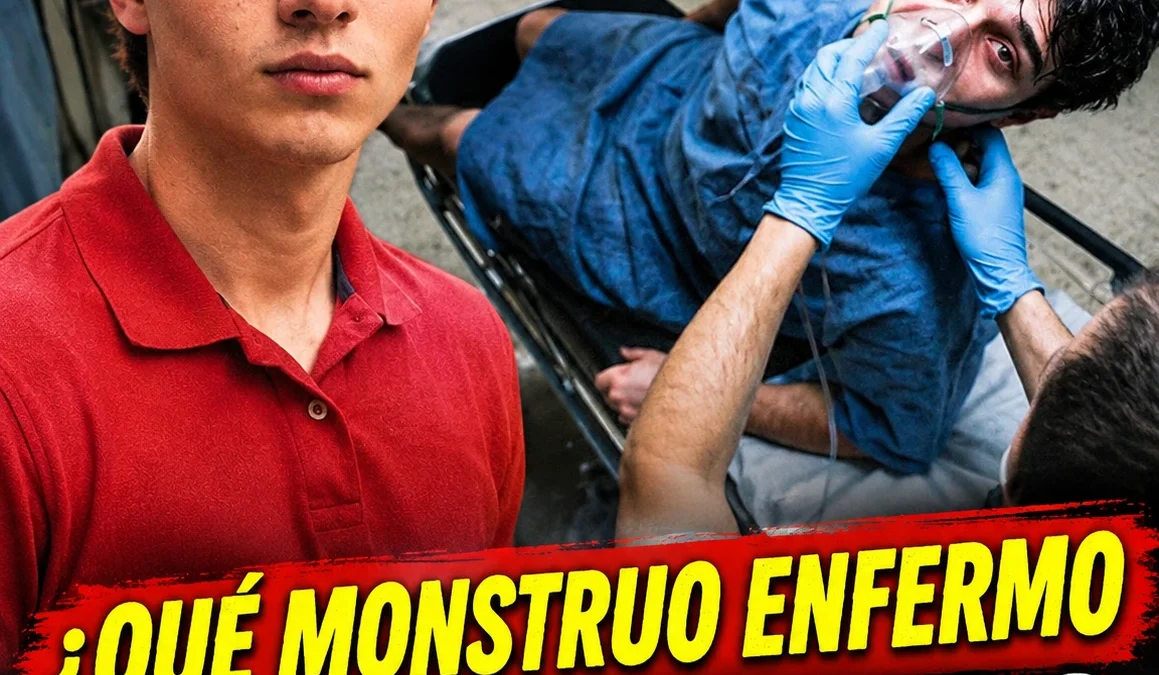
Callum was immediately placed on a stretcher, [music] secured, and loaded into an ambulance.
Escorted by patrol cars, the ambulance immediately set off for the nearest regional medical center to provide emergency care and [music] conduct a full battery of tests.
The man, who had been presumed dead for an entire year, had returned from the darkness of the forest, but his silence concealed the answers to the question of what exactly had happened to him during those long months.
The ambulance with its emergency lights flashing transported Callum to the emergency department of the regional medical center.
The on call team of doctors, trauma specialists, and intensivists immediately began a comprehensive examination of the patient to assess his overall health, level of dehydration, cardiovascular parameters, and the presence of any possible hidden internal injuries.
According to the medical staff’s testimony, which was later documented in detail in an official report for law enforcement, the very first minutes of this examination caused utter astonishment among all the specialists present in the room, which very quickly turned into deep concern.
To the great surprise of the doctors on duty during the initial visual examination of the young man’s skin, they found no characteristic injuries of the kind that inevitably result from a prolonged and grueling stay in the open wilderness.
There were absolutely no signs of severe frostbite, sunburn, massive bites from forest insects, or the characteristic deep scratches and abrasions that a person would inevitably sustain while moving for an extended period through impassible thicket and sharp rocky debris on his limbs, torso, and face.
The young man’s skin was extremely pale, practically defenseless against sunlight, which directly indicated his prolonged and uninterrupted stay in a confined space without the slightest exposure to natural ultraviolet radiation.
At the same time, the intensive care specialists were conducting the required laboratory tests and a series of standard rather painful procedures, including the insertion of intravenous catheters, [music] the connection of monitoring devices, and the collection of biological samples.
However, the young man remained completely silent.
According to a nurse who was on duty during that night shift and testified to investigators, the patient did not utter a single sound.
did not cry out and did not even flinch when large needles were inserted or when extensive treatment was administered to abrasions on his legs.
He maintained an absolute eerie and unnatural silence, remaining completely indifferent to any external stimuli, physical pain, or medical procedures, staring unblinkingly at a single spot on the ceiling of the emergency room.
To check the patency of his upper airways and the condition of his mucous membranes, the surgeon on duty asked the patient to open his mouth.
Since Callum showed no reaction whatsoever to verbal requests or questions, the medical staff gently lifted his chin and shown a special diagnostic flashlight into his mouth.
At that very moment, the entire medical team literally froze in deep shock at what they saw.
And the nurse on duty even took a few steps back [music] in surprise and horror.
According to the surgeon’s statement, which was later included in the official forensic medical investigation report, the condition inside the young man’s mouth was the result of an extremely complex, professional, and exceptionally brutal surgical procedure.
The young man’s tongue, as well as part of the soft tissues of the pallet and [music] larynx, had been completely removed.
The operation was performed using a special highly specific technique typically employed during the dissection or anatomical preparation of carnivorous animal carcasses [music] in professional taxiderermy or veterinary medicine.
All the anatomical incision lines were made with striking coldblooded precision, and the edges of the damaged soft tissues were closed with even neat medical sutures made from specialized [music] veterinary suture thread featuring a dense synthetic weave and distinctive markings.
Moreover, under the harsh light of a medical flashlight, [music] the doctors discovered yet another horrific and diabolical detail.
On the inside of the boy’s left cheek, a distinctive anatomical brand [music] had been burned into the skin.
It was a clear, deep, and seared mark left by a red-hot metal stamp [music] in the shape of a complex geometric symbol that clearly resembled an artist’s signature or a master’s monogram.
The nature of the healing of this thermal wound indicated that the branding had taken place several months earlier and that the procedure itself [music] had been performed under sedation or general anesthesia.
The doctor on duty immediately reported the findings to the medical c center’s administration [music] and the county sheriff’s department.
Within half an hour, a task force of forensic scientists and investigators from the major crimes unit arrived at the hospital.
The results of the initial examination radically and irrevocably changed the entire course of the law enforcement [music] investigation.
The police finally realized that they were not dealing with a simple case of getting lost, [music] exhaustion, or an accident on a mountain hiking trail, but with a chilling, meticulously planned abduction, prolonged confinement in complete isolation, [music] and deliberate, calculated mutilation.
The veterinary sutures and anatomical markings discovered clearly indicated [music] that Callum had spent this entire long year in the hands of a dangerous criminal who possessed professional surgical or anatomical skills had [music] access to specialized instruments, pharmaceuticals, and an isolated location [music] for carrying out such procedures.
The person who committed this horrific crime acted methodically, without the slightest haste, confidently, [music] and with a sense of complete impunity.
Investigators and forensic experts meticulously documented all the injuries found using specialized photo and video equipment to include this evidence in the materials of the new criminal case.
The entire hospital ward where Callum was staying was immediately placed under roundthe-clock heightened security by armed police officers and entry by any unauthorized persons was strictly prohibited.
The detectives realized that somewhere nearby in the forests [music] of the national park or in the surrounding remote settlements, the person capable of such cold-blooded cruelty [music] was still roaming completely at large.
And at any moment, this person might try to finish what they started or permanently eliminate the only conscious witness to their horrific crime.
The forensic evidence obtained radically changed the nature and scope of the entire law enforcement operation.
The missing person’s case was immediately reclassified as a special category of serious crimes involving kidnapping, torture, and the infliction of intentional bodily harm with particular cruelty.
The investigation drew in California’s top forensic experts, experienced detectives, and specialists in surgery, anatomy, and veterinary medicine.
A special medical commission was formed to issue an official report.
A second in-depth examination fully confirmed the doctor’s initial suspicions.
The surgical procedure was performed by someone with exceptional knowledge of anatomy, specific skills in handling the bodies of deceased animals, and experience working with soft tissues.
According to the chief forensic medical expert, whose statements were included in the official report, the method of tissue excision and the nature of the sutures directly pointed to techniques used in professional taxiderermy and the comparative anatomy of vertebrates.
The person who did this acted with expertise, used professional instruments, and carefully calculated the dosage of anesthetics or tranquilizers to ensure the victim did not die from pain shock [music] or blood loss.
The investigative team focused its efforts on analyzing the physical evidence discovered during the examination.
The main physical clues were a specific brandmark and rare veterinary sutures.
Forensic laboratories conducted detailed spectral and fiber analysis of the suture material.
It turned out that the suture thread used belongs to a highly specialized series with a synthetic coating which is used primarily in large veterinary clinics to suture the dense muscles of cattle and wild predators.
This material is not sold in regulararmacies and is supplied in limited quantities through specialized distribution networks.
At the same time, handwriting experts and forensic scientists examined the geometry and shape of the branded mark.
Computer modeling showed that the branding iron was handcrafted from a durable metal alloy based on a custom design.
The shape of the imprint bore the distinct features of a monogram combining Latin letters and graphic symbols used in ancient anatomical atlases.
It became clear to investigators that this mark served as a sort of signature for the criminal with which he marked the result of his gruesome work.
Detectives launched a comprehensive large-scale investigation into several target groups.
Investigators requested and analyzed the personnel files of all current and former national park employees, including rangers, gamekeepers, [music] scientific laboratory staff, technical personnel, and foresters.
Over the past 10 years, a separate branch of the investigation focused on local veterinarians, employees of private and public animal shelters, as well as taxiderermists [music] who lived or had workshops within a 50-mi radius of Yusede’s boundaries.
Law enforcement officials retrieved and thoroughly examined electronic databases of orders for specialized medical, surgical, and taxiderermy literature, as [music] well as professional equipment.
Over the past 5 years, analysts searched for any suspicious purchases [music] of high potency veterinary tranquilizers, specially shaped surgical scalpels, veterinary suture thread of a specific brand, and metalwork tools that could have been used to make a branding iron.
During this painstaking analytical work, investigators developed a psychological profile of the unknown perpetrator.
Forensic psychiatrists, after reviewing the case materials, concluded that they were dealing with a person suffering from a profound and extremely dangerous mental deviation.
This individual possessed a high level of intelligence, was extremely meticulous and withdrawn, and sought absolute control over objects.
He viewed a living human body not as a person but solely as voiceless material for the realization of his morbid fantasies and the creation of a chilling anatomical masterpiece.
As part of the investigation, [music] over 300 individuals who met the initial selection criteria were promptly screened.
Detectives interviewed suppliers of veterinary drugs, inspected private workshops in mountain villages, and conducted anonymous consultations [music] with specialists in the field of psychiatry.
All the data collected was compiled at the sheriff’s department’s central analytical center.
By [music] cross-referencing purchase records and lists of specialized materials, the circle of potential suspects slowly began to narrow.
The investigation identified a small group of people who had legal or informal access to remote areas of the park, possessed the necessary skills to work with anatomical specimens, [music] and ordered specific materials through restricted cataloges.
The police were preparing for the next decisive step, a targeted screening of individuals whose profiles most closely matched the findings [music] of the forensic medical and psychological examinations.
the painstaking and grueling analytical work of cross-referencing financial transactions, checking specialized registries of medical equipment shipments, [music] and thoroughly examining the National Park Services internal records finally yielded a substantial and irrefutable result.
The detectives, who had spent weeks cross-checking every minor detail, paid particular attention to systematic discrepancies in the property logs and unusual orders for high potency veterinary drugs.
The investigation clearly and unequivocally pointed to 54year-old Cyrus Hawthorne, a seasoned National Park Service employee who had served for over 20 years [music] as a senior ranger and wildlife inventory specialist.
For many years, Hawthorne had lived in a completely isolated service residence located in the most remote part of the forest, far from the park’s main tourist routes, service centers, and administrative offices.
After obtaining initial court orders to seize digital data and examine the suspect’s online activity, the cyber police uncovered a staggering and chilling trove of hidden information.
It turned out that over the past six years, Gotor had secretly ordered hundreds of rare medical publications, rare textbooks on comparative mamalian anatomy and monographs on the anatomy of wild animals through private online forums and specialized foreign cataloges via closed internet auctions.
Private forums and specialized foreign cataloges.
An analysis of his online search history revealed an obsessive and deep fixation on the detailed study of the structure of wild animal skulls, the mechanics of soft tissues, the temporalmandibular joints, and the structure of the oral cavity.
According to fellow rangers, whose testimonies were later included in detail in the criminal case file, Hawthorne always kept to himself, barely interacted with other staff members, and categorically refused any assistance [music] while patrolling his vast sector.
While working at the park, he spent years completely legally dissecting the remains of dead animals he found for the local natural history museum and scientific educational collections, gradually establishing his own private laboratory.
In his private diary entries, which were later seized by forensic investigators during a search, he described in detail his plan to perform an ideal anatomical transformation on a living person with the goal of creating a completely silent, utterly subjugated subject incapable of communication.
Given the high level of danger posed by the suspect, who had a hunting rifle, professional medical instruments, and potent chemicals in his constant possession, the operation’s leadership decided to carry out a forced arrest without first summoning him for questioning or conducting formal checks.
At 6:00 a.
m.
, a SWAT team from the sheriff’s department, supported by federal agents, surrounded Goour’s isolated house.
The arrest took place instantly and silently.
The suspect was found on the porch of his own home.
He did not have time to offer armed resistance or use chemical agents and was immediately subdued, restrained, and taken into custody.
Immediately after the arrest, a team of forensic scientists, medical examiners, investigators, and technicians began working on the property.
Their primary focus was on the concealed entrance to the house’s basement, whose extensive network lay deep underground beneath a thick layer of concrete and additional soundproofing materials.
During a thorough search of the basement, police discovered a makeshift but completely sterile operating room equipped with state-of-the-art surgical technology.
The room was equipped with professional shadowless medical lighting, a powerful ventilation system with multiple filtration stages, a special adjustable operating table with rigid metal restraints for the limbs and torso, as well as an autonomous electric generator.
Metal cabinets contained a large supply of highly concentrated [music] tranquilizers, typically used in veterinary medicine to subdue large predators, as well as a large set of specialized surgical and veterinary instruments, scalpels of various configurations, dilators, and disinfectant [music] solutions.
On a separate shelf near the operating table, forensic investigators found the key piece of evidence in the case, a massive metal branding iron with a wooden handle and components of a heating device.
A comparative trace evidence analysis conducted [music] directly at the crime scene revealed an exact match.
The shape of the imprint [music] and the dimensions of the metal die fully corresponded to the thermal injury on the inside of Callum Finch’s cheek.
In addition, several dozen packages of specialized veterinary sutures with rare markings, detailed diagrams of oral anatomy with Gothorne’s handwritten notes, and logs documenting the physiological condition of his [music] captive were seized from the operating room.
All items found were carefully documented, labeled, and packaged for inclusion in the forensic [music] evidence database.
The suspect was transported under heavy guard to a temporary detention facility and the investigative team began preparations for the detainees initial official interrogation.
After Cyrus Gothorne was officially taken into custody [music] and complete security was ensured in the medical ward.
The investigative team was able to move on to the most challenging phase of the investigation, reconstructing the exact sequence of events on that fateful day and the chronology of the following year.
Since the young man was unable to speak, the detectives and the adaptive communication specialists they had brought in developed a special interrogation protocol.
Callum used detailed schematic [music] maps of the national park, graphic tablets, and detailed written statements to reconstruct step by step the events from the moment of his disappearance.
According to Callum’s written testimony, [music] on that sunny day at the top of Gothor Falls, the asalant had been lying in weight among the dense thicket [music] and tall granite boulders.
The asalant knew the location well, was familiar with the schedules of tourist groups, and had carefully planned every move.
When the young man took just a few steps away from the main rest area, finding himself out of the direct line of sight of the other hikers, the [music] attacker acted swiftly and ruthlessly.
Gothorne suddenly leaped out from behind a rocky ledge and sprayed the young man directly in the face with a powerful concentrated [music] tranquilizer spray, a chemical agent that gamekeepers and rangers use in extreme cases to subdue and immobilize large aggressive wild animals.
The drug took effect almost [music] instantly.
Paralysis and loss of consciousness set in within seconds, so Callum didn’t even [music] have time to scream or call for help.
As he fell onto the rocks, the boy’s convulsive movement knocked his MP3 player off, and the edge of his jacket caught forcefully on a sharp granite ledge, leaving that same torn patch of fabric.
Gothorne, acting with absolute composure and precision, immediately picked up the unconscious young man’s body, dragged him through a pre-prepared technical opening between the rocks to a nearby service SUV and hit him in the back seat.
To thoroughly throw the investigation off track and lead search teams in the wrong direction, the criminal took the young man’s personal backpack.
Later, he drove it to a completely opposite part of the national park, dozens of miles away, and burned it using a chemical accelerant.
This maneuver proved entirely successful.
The police and rescue workers focused their attention on hard-to-reach thicket and remote areas, diverting any suspicion away from the gamekeeper lodge.
Callum spent the next 12 months in complete isolation inside the basement operating unit.
As the young man recounted in his notes, Hawthorne did not torture him in the conventional sense of the word, nor did he display any random aggression.
On the contrary, his captor treated him as a rare, unique anatomical specimen or scientific subject.
He carefully monitored his physical condition, checked his blood pressure and pulse, maintained sterile conditions in the room, and fed the young man liquid nutritional mixtures through a special medical tube.
The boy was practically constantly under the influence of sedatives and mild tranquilizers, which suppressed his will and made any attempts at resistance or escape impossible.
For months, Gothorne calculated every detail of his major anatomical operation.
He prepared his instruments, studied the incision lines, and waited for the moment when the captive’s body would reach the necessary physiological parameters.
After performing a complex surgical procedure involving the removal of the tongue and soft tissues and the application of his personal brand, the maniac waited for the wounds to heal completely and for the veterinary sutures to be removed.
A medical log seized during a search documented that this process lasted more than 2 months.
When the wounds had completely healed and the branded mark had taken on clear contours, Gothorne considered his morbid experiment finally complete.
The young man became perfectly and permanently mute, bringing his abductor’s anatomical plan to life.
having lost any further research interest in the subject, whose transformation had been successfully completed, and fully aware that Callum would be physically unable to utter a single word, say his name, or give oral testimony, Hawthorne decided to dispose of him without killing him.
Late at night, the criminal once again administered a dose of a sedative to the young man, tied his hands, loaded him into his service vehicle, and drove him to a remote section of the park.
Upon reaching the farthest cabin in the campground, Hawthorne simply led the exhausted young man out onto a forest trail, untied his bonds, and left him in the darkness, counting on him to remain forever a living monument to his chilling craftsmanship.
The investigators, having recorded every written word of Callums, obtained a complete and indisputable picture of the crime, [music] which left Hawthorne no chance of escaping punishment.
The official confirmation of Cyrus Hawthorne’s arrest and the disclosure of the shocking findings from his basement laboratory sparked an extremely powerful public outcry not only in California, but throughout the entire country.
News of the so-called Yoseite taxiderermist surgeon spread like wildfire through the world’s leading media outlets, transforming an ordinary crime story into the focus of intense scrutiny by hundreds of journalists, criminologists, analysts, and researchers of anomalous crimes.
[music] Reporters with TV cameras literally camped out in front of the Finch family’s home around the clock, trying to get even a brief comment, take a photo of the injured young man, or ask his parents about the details of his recovery.
To protect Callum from excessive and destructive psychological pressure, avoid constant harassment by the press, [music] and ensure he had a truly peaceful environment for his long-term recovery.
His parents made the only possible decision to move immediately.
They sold their house as quickly as possible, completely changed their phone numbers, deleted all their social media profiles, and moved to a small coastal town in a completely different state.
From then on, contact with the outside world, law enforcement, and judicial authorities was maintained exclusively through an officially hired representative and attorneys.
[music] Callum’s physical wounds gradually healed after he completed a complex and lengthy [music] course of intensive therapy at a medical center.
However, regaining his lost speech was anatomically impossible.
The young man was forced to adapt from scratch to a completely new silent reality of daily life.
Over the course of several months, under the guidance of experienced [music] specialists in deaf education and adaptive rehabilitation, he mastered American Sign Language, ASL.
In addition, he began actively and confidently using specialized digital apps on his tablet, [music] which allowed him to instantly synthesize and voice the text he typed for those around him.
Despite severe psychological trauma and a long exhausting period of depression, Callum found within himself tremendous [music] inner strength to carry on, learn, and grow.
2 years after his rescue from the maniac’s basement, he successfully passed [music] the entrance exams and enrolled in a prestigious art university in the department of graphic design and digital illustration.
Visual art became for him the primary and most profound means of communicating with the world.
A unique opportunity to express all those feelings, experiences, [music] fears, and emotions that he would never again be able to voice aloud.
His professors and classmates [music] noted the extraordinary precision of the finest details, the profound drama, and the distinctive academic style [music] in his graphic works.
The trial in the case of Cyrus Hawthorne lasted more than a year and a half due to numerous repeated and additional comprehensive psychological and psychiatric evaluations.
The defendant’s defense team insisted that he was completely insane due to severe pathologies.
After prolonged observation, psychiatric experts from leading federal medical centers diagnosed Hawthorne with a profound irreversible schizotypal personality disorder characterized by pronounced anatomical fixation, a complete breakdown of moral norms and a total lack of human empathy.
Based on these official findings, the court found Gotor not criminally responsible and ordered him to undergo compulsory treatment at a specialized closet type psychiatric facility under strict intensive supervision with no right to an early review of his case or a reduction in the severity of his treatment regimen.
According to witnesses present at both the open and closed sessions of the court proceedings, Gorththorne demonstrated complete indifference to the verdict and his own future throughout his time in custody.
During his prolonged interactions with medical experts and investigators, the maniac never showed any remorse, regret, or sense of guilt for what he had done to the young man.
On the contrary, he described every stage of the surgical procedures he performed with morbid pride and in great detail, sincerely considering Callum to be his sole, primary, and perfect anatomical masterpiece, whose final appearance fully corresponded to his warped notions of aesthetics.
The story of Callum Finch’s disappearance and return became a true turning point for the entire US National Park Service system.
Legislative bodies and the Department of the Interior significantly revised and strengthened general safety protocols within nature reserves on the most popular and hard-to-reach hiking trails in Yusede and other national parks.
Additional autonomous surveillance cameras with facial recognition systems and satellite communication towers were installed [music] and daily patrols by armed ranger units were significantly stepped up.
Operational procedures for inspecting private and government buildings located deep within forest areas were completely overhauled.
From now on, all such inspections were conducted exclusively by commissions involving external independent auditors.
Despite all the infrastructural and legislative changes implemented for many visitors to Yoseite, this story has forever remained a chilling and enduring reminder that the wilderness is by no means the only or even the most dangerous source of [music] threat.
The greatest disaster may not lie hidden among the endless pine forests, dangerous gorges, or steep rocky cliffs, but in human form, right among us, patiently waiting in the shadows for the right moment.
Cr: LastPathHere