¿Un piloto desaparecido durante nueve años regresó del desierto hablando una lengua muerta hace 4.
000 años?
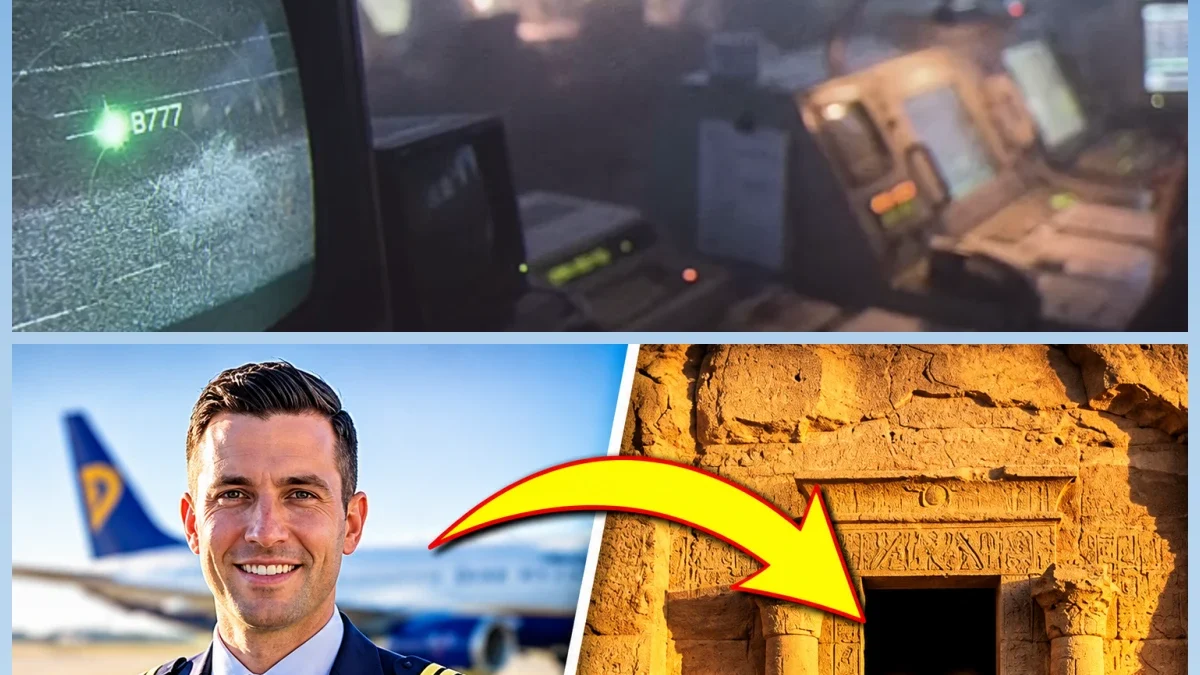
On March 15th, 2014, Captain Marcus Webb lifted off from Cairo International Airport at 2:47 a.
m.
bound for Casablanca with 180 passengers aboard Flight Egypt Air 447.
43 minutes into the flight, somewhere over the vast emptiness of the Sahara Desert, Web’s voice crackled through the radio one final time.
Cairo control experiencing minor navigation anomaly.
Adjusting course will advise.
Then silence.
The Boeing 777 vanished from radar screens as if it had simply dissolved into the desert night.
9 years later, a man stumbled out of the dunes, speaking a language that had been dead for 4,000 years.
The search for Flight 447 became one of aviation’s most baffling mysteries.
Satellite imagery revealed nothing.
Ground teams combed thousands of square miles of desert.
The aircraft, its crew, and 180 souls had simply ceased to exist.
Marcus Webb, a 34year-old pilot with 12 years of spotless service became a ghost story whispered in airport lounges.
The captain who flew into emptiness and never returned.
But ghosts don’t leave fingerprints, and they don’t speak fluent Middle kingdom Egyptian.
The Bedawin caravan first spotted him at dawn on April 3rd, 2023, moving through the western dunes like a sleepwalker.
Khalil al-Rashed, the caravan leader, would later tell investigators that the man approached their camp with the measured gate of someone who belonged in the desert.
Despite his western features and the inongruity of his presence, he wore clothes bleached white by sand and sun, fabric that should have been rags, but somehow held together with an almost ceremonial integrity.
He spoke to us in the old tongue, Khalil told the authorities through an interpreter, his weathered hands gesturing toward the endless horizon.
Not Arabic, not any language the living should know, but we understood him.
The words entered our minds like water entering sand.
The man had said, according to Khalil’s account, I seek the path of Anubis beneath the stars.
The weighing of hearts cannot be delayed.
Then he collapsed and they saw the tattoo on his left shoulder, the distinctive wings and globe insignia of Egypt Air pilots.
Dr.
Sarah Chen, the forensic anthropologist who first examined the wanderer, had seen her share of desert survivors.
Dehydration madness could make [music] people babble in tongues, create false memories, scramble cognitive function until the brain produced elegant nonsense.
But this was different.
The man’s knowledge wasn’t fragmentaryary or hallucinatory.
It was comprehensive, academic, fluent, beyond any reasonable explanation.
He conjugated verbs that we only know from papyrus fragments.
Dr.
Chen would later testify.
He used idioms that appear in texts from the Middle Kingdom, but nowhere else.
When I showed him hieroglyphic passages, he read them aloud with pronunciation guides we didn’t even know were correct until linguistic specialists confirmed it weeks later.
The DNA results arrived on April 10th, 7 days after the discovery.
The genetic markers were unambiguous.
The man found wandering the Sahara was Marcus Webb, missing pilot of Flight Egypt Air 447.
But the implications made no sense.
According to every medical examination, Webb hadn’t aged a day since his disappearance.
His cellular structure, bone density, even his dental work remained exactly as recorded in his 2013 medical files.
9 years had passed without leaving a mark on his body.
The impossibility deepened when investigators realized Webb remembered nothing of his disappearance.
No crash, no survival ordeal, no explanation for his desert emergence.
His memory simply ended with that final radio transmission in March 2014 and resumed with waking up in a Cairo hospital bed speaking ancient Egyptian and asking for someone named Thutmos who had been dead for millennia.
Detective Inspector Omar Hassan of the Cairo Metropolitan Police had investigated missing person’s cases for 15 years, but nothing in his experience had prepared him for Marcus Webb.
The pilot sat across from him in the interview room looking exactly as he had in photos from 2014.
Same sandy hair, same green eyes, same thin scar above his left eyebrow from a childhood accident.
Time had refused to touch him.
You understand why we’re having difficulty with your story, Mr.
Webb? Hassan said, studying the file before him.
You vanish for 9 years, survive in one of Earth’s most hostile environments, emerge speaking a dead language, and have no memory of any of it.
Webb looked up, and when he spoke, his accent carried inflections that belong to no modern dialect.
I remember the weighing, the heart placed upon the scales against the feather of Mahat.
Those who fail the test feed Amit the devourer.
But I cannot recall how I came to stand before the judges.
Hassan had reviewed the linguistic analysis reports.
Whatever Webb was speaking, it wasn’t the product of delirium or psychological trauma.
The vocabulary was vast, the grammar sophisticated, the cultural references accurate to historical periods that most scholars spent lifetimes studying.
Somehow during his nine missing years, Marcus Webb had become fluent in the language of ancient pharaohs.
The first theft occurred 6 days after Web’s discovery.
The Egyptian Museum in Cairo housed the largest collection of fionic antiquities in the world.
Its security system had been upgraded in 2019 with motion sensors, infrared cameras, and pressure sensitive floors that could detect the weight of a paperclip.
On the night of the April 9th, 2023, someone walked through those defenses as if they didn’t exist and removed three priceless artifacts.
a golden death mask from the Middle Kingdom, a ceremonial dagger inscribed with protective spells, and a papyrus scroll containingerary rights that had never been fully translated.
The theft was discovered at 6:15 a.
m.
when the morning security team noticed the empty display cases.
The cameras showed nothing.
The motion sensors had never triggered.
The only evidence of intrusion was the missing artifacts and a single footprint pressed into the dust beside the sarcophagus hall.
A bare human foot size 10 with distinctive pressure points that forensics would later match to Marcus Webb’s gate pattern.
Dr.
Aamira Farid, the museum’s chief curator, stood in the violated halls that morning trying to comprehend the impossible.
Whoever did this knew exactly what they wanted, she told the investigators.
They bypassed thousands of valuable pieces to take three specific items, and they left no trace except that single footprint, as if they wanted us to know they’d been here.
The selected artifacts shared no obvious connection except their age.
All dated to Egypt’s [music] Middle Kingdom period, roughly 255 to 1650 B.
CE.
The death mask had belonged to a minor nobleman named A&M Heb.
The dagger bore the cart of Sinuset III.
The papyrus contained prayers for safe passage through the underworld.
Random selection seemingly except for their shared historical period.
The connection to Web seemed obvious but impossible.
He had been under medical observation at the time of the theft, sedated and monitored around the clock.
Hospital records confirmed his presence.
Video surveillance showed him sleeping peacefully in his hospital bed while across the city, someone with his exact biometric markers was walking through the museum’s security grid like a phantom.
Inspector Hassan reviewed the hospital footage frame by frame, searching for any gap in surveillance, any moment when Webb could have left undetected.
The records were seamless.
Webb had been there all night, breathing steadily under medical observation, while his impossible double committed the perfect crime.
The second theft occurred in London 3 days later.
The British Museum’s Egyptian collection rivaled Cairo’s incope and security.
On the night of April 12th, someone entered the Egyptology wing and removed four artifacts.
Two kopic jars from the reign of Amenhep II, a limestone relief depicting the weighing of hearts ceremony, and a gold amulet in the shape of Anubis, the jackal-headed god of the underworld.
The security footage showed a figure moving through the corridors with purposeful efficiency, never hesitating, never checking displays, walking directly to specific cases as if following a memorized map.
The person’s height, build, and movement patterns matched Marcus Webb exactly.
But when Metropolitan Police contacted Cairo, they learned that Web had been undergoing psychological evaluation at the exact time of the London theft 3,000 mi away.
Dr.
James Morrison, the museum’s head of security, had worked in protective services for 20 years.
He’d guarded everything from royal residences to nuclear facilities.
The British Museum theft challenged everything he understood about security and physics.
The intruder moved like someone who’d studied our layout for months, Morrison told investigators.
Every camera angle, every blind spot, every sensor placement.
But here’s what doesn’t make sense.
They approached the artifacts with reverence.
They handled each piece with the care of a curator, not the haste of a thief.
This wasn’t a robbery.
It was more like a retrieval.
The stolen artifacts again dated to Egypt’s Middle Kingdom.
The Kopic jars had held the preserved organs of a priest named Camwiset.
The limestone relief depicted the same heartweighing ceremony that Webb kept referencing in his interviews.
The Anubis amulet bore hieroglyphic inscriptions that, according to the museum’s experts, had never been fully deciphered.
By now, authorities across three continents were tracking what appeared to be a coordinated theft ring operating with impossible precision.
But the thieves or thief left just enough evidence to mock traditional investigation methods.
Fingerprints that matched Marcus Web’s exactly gate patterns identical to his biomechanical profile.
security footage showing his face clearly enough for facial recognition software to confirm identity with 99.
7% accuracy.
Yet, Web remained under constant surveillance in Cairo.
His every movement documented and verified.
The New York theft occurred on April 15th while Webb was undergoing an MRI scan at Cairo’s National Hospital.
The Metropolitan Museum of Arts Egyptian Wing lost five pieces.
a golden scarab pendant, two papyrus fragments containing middle kingdom prayers, a bronze figurine of Thoth weighing a human heart, and a ceremonial cyrum inscribed with the name of Pharaoh Senus II.
Dr.
Rebecca Martinez, the Met’s Egyptian department head, discovered the theft during her morning rounds.
The missing pieces left gaps in the collection like pulled teeth, but what disturbed her most was the pattern of selection.
Every stolen artifact relates to the afterlife journey in Middle Kingdom theology, she explained to the FBI task force.
The weighing of hearts, the judgment of souls, the passage through the underworld.
It’s as if someone is collecting the tools for a specific ritual, one that hasn’t been performed in 4,000 years.
The security footage from New York showed the same impossible figure, moving with the same purposeful calm, approaching artifacts with the same reverent precision.
But this time, the cameras captured something new.
The thief pausing before a glass case containing a reproduction of the Book of the Dead, touching the surface gently, and appearing to mouth words in what lipreading experts later identified as Middle Kingdom Egyptian.
The words according to linguistic analysis translated roughly as the heart remembers what the mind forgets.
In Cairo, Marcus Webb sat in his hospital room sketching on paper provided by his doctors.
The drawings emerged from his hands without conscious direction.
Detailed maps of desert terrain marked with coordinates that corresponded to no known archaeological sites.
When questioned about the sketches, Webb would look at them with surprise, as if seeing them for the first time.
I don’t remember drawing these, he told Doctor Chin during one of their sessions.
But I know they’re important.
I know something is buried at these locations, something that’s been waiting in the sand for thousands of years.
The coordinates fascinated the research team because they followed patterns consistent with Middle Kingdom burial practices, alignments with specific constellations, distances measured in royal cubits, positioning that respected the ancient Egyptian understanding of sacred geometry.
Web was unconsciously mapping locations that predated modern archaeology by millennia.
But when satellite imagery examined those coordinates, the desert appeared empty.
sand, rock, the occasional Bedawin path.
No structures, no evidence of human presence.
Either Web’s knowledge was false, or whatever lay buried there remained perfectly hidden beneath the dunes.
Doctor Sarah Chen had interviewed hundreds of trauma victims during her career, but Marcus Webb presented challenges that transcended psychology into realms she couldn’t name.
His memories appeared to exist in separate layers.
surface recollections of his life as a pilot and deeper knowledge that belonged to someone else entirely.
Marcus describes flying modern aircraft with perfect technical accuracy she noted in her reports, but he also provides detailed accounts of mummification procedures that match archaeological evidence from 2000 B.
CE.
He knows the names of Pharaoh’s pets, the layout of palaces that were ruins before the pyramids were built, the private prayers of priests whose names appear on no surviving inscriptions.
The knowledge wasn’t academic.
It was intimate, personal, lived.
Webb spoke of ancient Egypt not as a historian studying the past, but as someone remembering home.
During one session, doctor Chen showed Webb a photograph of hieroglyphic text that had never been successfully translated.
He glanced at it and immediately began reading aloud.
Here lies Nebet, beloved of Sobeck, whose heart was found pure when weighed against the feather of truth.
May her bar return to her body at dawn.
May her c find sustenance in the offering fields.
May she walk with the blessed dead until the stars fall from the sky.
Later verification by Egypt’s most respected linguists confirmed the translation’s accuracy.
The hieroglyphic passage described a burial that had occurred 37 centuries ago.
Marcus Webb had read it as easily as a morning newspaper.
The investigation expanded internationally as thefts continued across Europe and North America.
Munich’s agyptic museum lost three Middle Kingdom pieces on April 18th.
The Louv’s Egyptian collection was struck on April 21st.
The pattern remained consistent.
Artifacts from the same historical period, thefts executed with impossible precision, security footage showing Marcus Webb’s unmistakable features.
While the real web remained under surveillance in Cairo, Interpol created a special task force to coordinate the investigation.
Agent Maria Santos, assigned to lead the international response, had tracked art thieves across six continents.
But this case violated every principle of criminal behavior she’d studied.
Typical art theft follows predictable patterns, Santos explained to her team.
Thieves target the most valuable pieces.
They work quickly to minimize exposure, and they move merchandise through established networks.
Our suspect violates every rule.
He ignores priceless objects to take pieces that most people have never heard of.
He operates with methodical calm that suggests no fear of capture.
And he’s apparently stealing items for purposes we can’t identify.
The stolen artifacts shared connections beyond their historical period.
Many contained references to the heartweighing ceremony, the central judgment that determined a soul’s fate in the ancient Egyptian afterlife.
Others depicted Anubis, Thoth, and Mahat, the gods responsible for guiding and judging the dead.
Together, they formed a collection that would allow someone to perform rituals that scholars thought were purely symbolic, literary devices rather than actual practices.
But who would want to conduct ancient Egyptian death rituals in the modern world? And how did any of this connect to a missing pilot who spoke dead languages and drew maps of empty desert? The answer began emerging when Dr.
Ahmed Mansour, Egypt’s leading archaeologist, received an unexpected visitor at his office in Giza.
Marcus Webb appeared without appointment or escort, having somehow left his hospital room despite roundthe-clock surveillance.
He sat across from Dr.
Mansour’s desk and spoke in Middle Kingdom Egyptian, so fluent that Mansour, who had spent 40 years studying the language, felt like a child attempting adult conversation.
I know where they buried the heretic’s treasure, Webb said, his voice carrying accents that belong to the court of pharaohs.
The one who tried to change the old ways, who thought he could alter the journey through the underworld.
They took his innovations and buried them deep.
But I remember the place.
I remember standing there when the sand was still fresh on the hidden chambers.
Dr.
Mansor understood enough ancient Egyptian to follow Web’s meaning, but the implications were staggering.
Webb was describing events from Egypt’s Middle Kingdom as if he’d witnessed them personally.
More disturbing, he was referencing archaeological sites that had never been discovered.
Innovations that official history claimed had never existed.
What heretic? Dr.
Mansour asked in modern Arabic.
Web’s eyes focused as if remembering where and when he was.
I I don’t know, he said in English.
Did I just say something? I have these moments where words come out, but they don’t feel like my words.
The session was recorded and linguistic experts spent weeks analyzing Web’s speech patterns.
The conclusion was inescapable.
During his episodes, Webb spoke Middle Kingdom Egyptian with the fluency of a native speaker.
His pronunciation matched theoretical models that scholars had debated for decades.
He used regional dialects that were barely understood by modern experts.
Whatever had happened to him during his nine missing years, he’d somehow acquired knowledge that existed nowhere in contemporary academia.
But the implications reach beyond linguistics when Dr.
Mansour cross-referenced Web’s statements with recent archaeological surveys.
The heretic’s treasure that Webb described matched references in recently discovered papyrus fragments.
documents that mentioned a Middle Kingdom pharaoh who had attempted to reform burial practices and whose innovations had been deliberately erased from official records.
The pharaoh’s name was Camwased and according to the fragments, he tried to create new pathways through the underworld, alternatives to the traditional heartweighing ceremony.
His innovations had been considered so dangerous that his successors had not merely destroyed them.
They’d buried them in secret locations and removed all references from official inscriptions.
Webb was describing with impossible accuracy historical events that had been deliberately hidden for 4,000 years.
The investigation took on new urgency when analysts noticed that the stolen artifacts weren’t random selections from Middle Kingdom collections.
They were specific tools that would be necessary for conducting Camwaset’s forbidden rituals.
The thief wasn’t collecting ancient art.
They were assembling the components needed to perform ceremonies that had been banned in ancient Egypt and lost to time.
Someone was planning to conduct a 4,000-year-old experiment in manipulating death itself.
And Marcus Webb, the missing pilot who spoke languages of the dead, was either the architect of this impossible plan or its unwilling instrument.
The desert stretched endlessly beyond Cairo’s margins, holding its secrets beneath miles of shifting sand.
Somewhere in that vastness, coordinates marked on Web’s unconscious sketches pointed toward burial sites that predated recorded history.
Whatever lay hidden there had waited four millennia for someone with the right knowledge to find it.
The thefts continued, building towards some purpose that investigators could sense but not define.
Each stolen artifact brought the collection closer to completeness.
Each security camera recorded the impossible image of a man who existed in two places simultaneously.
And in his hospital room, Marcus Webb drew maps of the desert with increasing urgency, his hand moving across paper as if guided by memories that weren’t his own.
The coordinates multiplied, forming patterns that suggested not single burial sites, but an entire network of hidden chambers stretching across the Sahara.
The ancient Egyptians had believed that the desert was a threshold between the world of the living and the realm of the dead.
They’d built their tombs facing west toward the setting sun and the underworld that lay beyond the horizon.
But what if they’d built more than tombs in the desert? What if they’d constructed something that could breach the boundary between life and death itself? The breakthrough came when Dr.
Chen discovered Web’s sleepwalking episodes.
Hospital cameras captured him rising from his bed at precisely 3:17 a.
m.
every night, walking to the window and tracing symbols in the condensation on the glass.
The symbols weren’t random.
They were hieroglyphs forming complete sentences in Middle Kingdom Egyptian.
The stars align, the path opens, the weighing cannot be delayed, appeared night after night in his unconscious script.
But on April 23rd, the message changed.
Tomorrow, the heart finds its scale.
The judgment of Cameet begins.
Dr.
Chen called Inspector Hassan immediately.
Whatever was driving the thefts, whatever purpose the stolen artifact served, it was reaching completion.
The next day would bring answers or catastrophe.
Hassan arrived at the hospital to find Web’s room empty.
The guards swore they hadn’t seen him leave.
The camera showed him lying in bed at 2:45 a.
m.
Then static filled the screens for exactly 32 minutes.
When the footage resumed, the bed was vacant, sheets still warm to the touch.
But this time, Web hadn’t simply vanished.
He’d left behind a detailed map drawn in what appeared to be his own blood, showing a route through the western desert to coordinates that matched the most prominent location in his unconscious sketches.
At the bottom, in hieroglyphs that Dr.
Chen translated with growing dread, he’d written, The weighing of hearts begins at sunset.
The gods wait in the buried chamber.
I go to remember what I forgot.
The coordinates led to a region 200 m southwest of Cairo where satellite imagery showed nothing but endless dunes.
But as Hassan assembled a search team, reports began filtering in from around the world.
The security footage from every museum theft was simultaneously broadcasting the same impossible image.
Marcus Webb standing in each location, speaking in ancient Egyptian, and carefully placing the stolen artifacts into leather satchels that hadn’t appeared in the original recordings.
Agent Santos contacted Hassan from Interpol headquarters.
The footage is changing, she told him, her voice tight with disbelief.
Every security system that recorded the thefts is now showing additional content that wasn’t there before.
It’s as if the cameras are remembering things they never saw.
The revised footage revealed Webb collecting the artifacts with ritualistic precision, arranging them according to patterns that matched ancient burial practices.
In the British Museum recording, he was now visible, bowing to each piece before removing it.
The Met footage showed him speaking what linguists confirmed were prayers for safe passage through the underworld.
The recordings were documenting events that appeared to be happening across time simultaneously.
past thefts gaining new details as the present moment approached some crucial convergence.
Hassan’s team reached the coordinates at 4:30 p.
m.
As the sun began its descent toward the western horizon, the landscape appeared unchanged from a thousand years of wind and sand.
But their ground penetrating radar detected anomalies 30 ft below the surface, regular geometric shapes that suggested human construction.
Dr.
Mansour had joined the expedition, bringing equipment to analyze any archaeological finds.
As they established their search perimeter, he pointed to formations in the sand that were invisible to untrained eyes, but unmistakable to someone who’d spent decades excavating buried sites.
The dunes here aren’t natural, he told Hassan.
Look at the way they flow.
They’re following the outline of structures below.
This entire area is built on top of something massive, a complex that predates the pyramids.
The excavation began immediately, racing against the approaching sunset.
20 ft down, they hit worked stone.
30 ft revealed a corridor entrance sealed with blocks bearing the cartou of Pharaoh Caamasid, the heretic king, whose innovations had been erased from official history.
Inside the hidden chamber, preservation was perfect.
The dry desert air had maintained murals depicting scenes never found in any other Egyptian tomb.
Alternative paths through the underworld.
Ceremonies where hearts were weighed not against a feather but against golden scarabs.
Rituals where the dead could speak directly with the living.
At the chamber center stood an altar unlike anything in archaeological records.
a scale with two balance pans, one containing a human heart preserved in crystal, the other empty and waiting.
Around the altar, arranged in precise ritual order, were the artifacts stolen from museums worldwide.
Marcus Webb had been there before them, setting up a ceremony 4,000 years in the making.
Hassan found Webb in the deepest chamber, standing before a wall covered in hieroglyphic text that seemed to shift and writhe in the torch light.
He wore the white linen robes of an ancient priest, though no one could explain where he’d acquired them.
In his hands, he held the golden death mask stolen from Cairo’s museum, speaking to it in Middle Kingdom Egyptian as if addressing an old friend.
Marcus, Hassan called softly, approaching with the caution of someone nearing a sleepwalker.
It’s time to come home.
Webb turned and his eyes held depths that hadn’t been there before.
Ancient knowledge layered beneath modern consciousness like geological strata.
When he spoke, his voice carried the authority of priesthood that belonged to dynasties lost to sand.
I am not Marcus Webb, he said.
The words flowing between ancient Egyptian and English as if the languages were the same river seen from different banks.
I am Cam Waset, son of Senniset, priest of Anubis, seeker of the true path through death.
I have worn this body for 9 years, teaching it what it needed to know, preparing it for this moment when the stars align and the great weighing can commence.
Doctor Chen, who had followed the expedition, stepped forward with her recording equipment.
What happened to the plane, to the passengers? The being wearing Web’s face smiled with infinite sadness.
The aircraft passed through a fold in time above the desert, where the ancient burial grounds thin the barrier between worlds.
The machine fell into sand 4,000 years ago.
The passengers found their judgment immediately.
Their hearts weighed, their fates decided, their journey complete.
Only this vessel remained, needed for a purpose that required both modern movement through the world and ancient wisdom of the underworld’s ways.
Hassan felt reality shifting around him like sand and wind.
You’re saying you’re a 4,000-year-old pharaoh possessing a missing pilot? I am saying that death is not the ending your modern world believes it to be.
The ancient rituals contain truths your civilization has forgotten.
The heartweighing ceremony is not symbolic.
It is the actual mechanism by which consciousness transitions between life and what comes after.
But the old ways had flaws, opportunities for deception, paths that led the guilty to false paradise.
web or the entity inhabiting him gestured toward the wall murals.
I sought to perfect the judgment to create ceremonies where no heart could lie upon the scales.
My innovations threatened those who profited from the old corruptions.
They buried my work and hoped time would erase memory, but consciousness persists.
Inspector, what dies in flesh lives on in knowledge, waiting for the right moment, the right vessel, the right alignment of stars to complete what was begun.
Dr.
Mansour was photographing the murals trying to document discoveries that would reshape understanding of ancient Egypt.
The artwork depicted weighing ceremonies where multiple hearts were balanced simultaneously.
Where the scales could reveal not just individual guilt but collective truth where the judgment of souls could ripple backward through time to correct injustices that had been hidden.
The stolen artifacts, Hassan said, pieces falling into place.
You needed them to perform your corrected ritual.
Each piece serves a specific function in the true weighing ceremony.
The death masks preserve the identity of souls across millennia.
The ceremonial daggers can cut through deceptions that hearts carry.
The papyrus scrolls contain prayers that open pathways between what was and what is.
Together, they form the tools necessary to judge not just individual souls, but the truth of entire civilizations.
Web moved to the altar, placing the death mask on the empty scale pan.
Immediately, the chamber filled with sounds that shouldn’t exist.
Voices speaking in languages that predated human civilization.
Whispers of judgment carried on desert winds that had blown for thousands of years.
Who are you judging? Dr.
Chen asked, her scientific mind struggling to process impossibilities.
Everyone, Webb replied simply.
The weighing of hearts is not complete until all hearts have been measured.
Every soul that has lived, every consciousness that has sought passage through death, every civilization that has claimed to understand justice.
The ceremony I begin tonight will ripple across time, weighing the collective heart of humanity against the feather of absolute truth.
The implications struck Hassan like physical blows.
You’re talking about judging the entire human race.
I am talking about completing a ritual that should have been finished 4,000 years ago.
Your modern world stands upon foundations built by those who escaped true judgment.
Pharaohs who claimed divine right while oppressing millions.
Priests who sold false absolution to murderers.
Kings who started wars for personal glory.
Their hearts were never properly weighed because the old ceremonies could be corrupted, bribed, deceived.
Web began arranging the remaining artifacts around the altar.
Each piece clicked into place with precision that suggested they had been designed as components of a single mechanism.
The chambers murals seemed to respond to their positioning.
Hieroglyphs glowing with inner light that revealed additional text previously invisible.
My corrected ritual cannot be deceived.
Hearts reveal their true weight when measured by ceremonies perfected through centuries of refinement.
The guilty cannot hide behind power, wealth, or the passage of time.
Justice delayed is not justice denied.
It is justice perfected.
Dr.
Dr.
Chen was recording everything, knowing she was documenting either the greatest archaeological discovery in history or the detailed delusions of a man traumatized by nine missing years.
But the evidence of her eyes suggested realities beyond psychology textbooks.
The ancient artifacts were functioning as if they were still connected to whatever forces had originally empowered them.
What happens when the weighing is complete? Hassan asked.
Webb paused in his preparations, and for a moment, the pilot’s consciousness seemed to surface through the [music] ancient persona.
I don’t know, he said in his original voice, confusion replacing certainty.
I remember flying the plane, then nothing until waking up speaking Egyptian.
But I dream of scales, endless scales stretching across time and space, weighing hearts from every age.
I dream of balance, of justice, of truth so pure it burns.
The ancient presence reasserted itself.
When the ceremony concludes, every soul that has ever lived will face judgment according to its true nature.
Those found pure will continue their journey.
Those found wanting will face consequences that have been delayed but never escaped.
The universe will balance its scales and justice will be complete.
Hassan realized they were witnessing either the culmination of humanity’s oldest spiritual tradition or the elaborate delusion of a man broken by impossible circumstances.
Either possibility terrified him equally.
The sun touched the horizon, painting the desert gold and crimson.
Webb completed the artifact arrangement as shadows stretched across the chamber floor.
The ancient hieroglyphs now glowed with steady light, and the air itself seemed to thicken with presence, as if consciousness from across millennia was gathering to witness the completion of history’s longest delayed trial.
The stars align, Webb announced, his voice echoing with harmonics that belong to multiple speakers.
The ceremony begins.
He lifted the crystal preserved heart from the scale and held it toward the dying light.
The organ began to pulse as if alive, synchronizing with a rhythm that seemed to emerge from the earth itself.
Around the chamber, the murals moved, painted figures stepping from wall to wall, carrying out the motions of rituals that predated recorded history.
Hassan felt the weight of every decision he’d ever made, every moment of moral compromise, every time he’d chosen expedience over justice.
The chamber’s influence was affecting all of them.
Dr.
Chen clutched her recorder as if it were an anchor to sanity, while Dr.
Mansour knelt before the moving murals, whispering prayers in Arabic mixed with ancient Egyptian.
The weighing had begun, and they were all subjects of its judgment.
The heart in Web’s hands pulsed brighter, and Hassan understood that this wasn’t just one preserved organ.
It was somehow every heart that had ever beaten, every conscience that had ever grappled with right and wrong, every soul that had ever sought meaning in the darkness between life and death.
The scale began to tip.
Outside across the world, sensitive equipment registered anomalous readings.
Electromagnetic fields fluctuated in patterns that matched brain waves.
Seismographs recorded rhythmic pulses from deep beneath the Earth’s surface.
Radio telescopes detected signals from space that carried the mathematical signatures of heartbeats.
The weighing of hearts was indeed happening on a scale beyond individual judgment.
It was measuring the moral weight of consciousness itself.
In the buried chamber, Webb placed the collective heart upon the scale.
The balance swayed as if weighing the entirety of human choice across all of history.
The feather of maat on the opposite pan glowed with light that revealed truth in its purest form.
Not the truth of facts, but the truth of moral consequence of justice undeluded by power or time.
Hassan watched the scales tip back and forth, understanding that the result would determine not just ancient theological debates, but the fundamental nature of reality itself.
If humanity’s collective heart proved heavier than absolute truth, what would that mean for every human who had ever lived or would ever be born? The scales settled into perfect balance.
For a moment that lasted eternity, the chamber held absolute silence.
Then Webb spoke, his voice carrying both ancient authority and modern wonder.
The heart is true.
Humanity is worthy of continued existence.
The journey through death leads not to punishment, but to understanding.
Justice is served not through condemnation, but through the completion of wisdom.
The light faded from the hieroglyphs.
The artifacts became once again ancient relics instead of functioning ceremonial tools.
The preserved heart crumbled to dust.
Its purpose finally fulfilled.
Marcus Webb collapsed.
The ancient presence leaving him as suddenly as desert wind dies at sunset.
When Hassan reached him, the pilot’s eyes held only modern confusion and the exhausted relief of a man waking from dreams too vast for mortal consciousness.
Where am I? Web asked in English, his voice carrying no trace of ancient languages.
The last thing I remember is flying over the desert.
There was a storm.
Lightning that looked wrong somehow, then nothing.
Dr.
Chen knelt beside him, checking his vital signs.
You’ve been missing for 9 years, Marcus.
You walked out of the desert speaking ancient Egyptian.
You’ve been part of something that She paused, looking around the chamber that now seemed like an elaborate archaeological site rather than a functioning temple.
Something that may have saved the world.
The investigation concluded with more questions than answers.
The stolen artifacts were returned to their museums where they resumed being historically significant but mundane objects.
The hidden chamber was sealed, pending further archaeological study, though subsequent excavations found only empty corridors and faded murals that no longer moved.
Marcus Webb underwent extensive medical and psychological evaluation.
His memories of the missing 9 years never returned, though he occasionally spoke Egyptian phrases in his sleep, words that linguistic experts confirmed were prayers of gratitude [music] to gods whose names had been lost for millennia.
The passengers of Flight Egypt Air 447 were never found.
Satellite surveys of the coordinates where ancient burial grounds might exist revealed nothing but sand.
Whatever had happened to them remained as mysterious as Web’s survival and transformation.
But across the world, sensitive individuals reported the same dream in the days following the desert ceremony.
standing before scales of impossible size, watching their hearts weighed against a feather of pure light, and feeling for the first time in their lives that justice was not an aspiration, but a fundamental property of existence itself.
Inspector Hassan kept the case file on his desk long after official interest waned.
Sometimes late at night when the precinct was empty, he would read through the reports and wonder if they had witnessed the completion of humanity’s oldest trial, a specieswide judgment that had taken 4,000 years to conclude.
The scales had found humanity’s heart true, but barely.
The balance had been perfect, suggesting the consciousness itself existed on the knife’s edge between wisdom and folly, between justice and corruption, between the light of truth and the darkness of willful blindness.
Marcus Webb returned to flying, though he never again took roots over the Sahara Desert.
When asked about his missing years, he would simply say that some experiences exist beyond memory.
In places where the heart remembers what the mind cannot hold, the desert kept its secrets, as deserts always do.
But sometimes, when the wind blows across the dunes at sunset, Bedawin caravans report hearing voices speaking in languages that died with pharaohs.
Not cries of the lost, but whispers of the found.
consciousness that has passed through the weighing of hearts and emerged worthy of whatever lies beyond the horizon where the living world meets the realm of eternal truth.
The ancient Egyptians believe that death was not an ending but a graduation, a passage from one form of existence to another, available only to those whose hearts proved lighter than a feather when placed upon the scales of absolute justice.
In a buried chamber beneath the Sahara, those scales had finally balanced perfectly.
Humanity had passed its oldest test.
Not through perfection, but through the accumulated weight of every soul that had chosen truth over convenience, justice over power, love over fear.
The weighing of hearts was complete.
The judgment was mercy.
The journey continued, and somewhere in the vast emptiness of the desert, the wind carries whispers in languages of the dead, speaking words that translate simply as, Well done.
Cr: Nightmare Trails